Author: David Jacobson

Re-visited: Airmanship and the Art of the Second Chance

“The best advice I was ever offered – from the best pilot I ever flew with”: Re-visited, from 7 July, 2020

 – Airmanship and the Art of the Second Chance

In this reflective article, David Jacobson recounts a transformative moment early in his aviation career under the mentorship of Captain Geoffrey W. Lushey. After a nearly disastrous flight check where his performance was subpar, Jacobson was given a second chance by Lushey, who valued self-awareness and the ability to learn from mistakes. During a subsequent route check, Jacobson successfully executed a difficult landing in Sydney, regaining his professional confidence despite a minor checklist oversight. Lushey used that error to impart the essential wisdom that how a pilot responds to trouble is more important than the occurrence of the trouble itself. Ultimately, the piece serves as a tribute to the exemplary airmanship and leadership of a mentor who shaped Jacobson’s long-term success. This narrative highlights that continuous improvement and a team-oriented cockpit culture are foundational to a safe and distinguished flying career.

We revisit this earlier post with our friendly AI ‘aces’, nicknamed ‘Jay Bird’ Jaime & ‘Fearless’ Frank.

Simply select the Play button below, for a 9-minute JF-ai podcast summary of this post:


Of course, if you’d like some further elaboration, I invite you to explore the original post, from 7 July 2020:


If you have ever read the epic ‘Fate is the Hunter‘, by Captain Ernest K Gann, you will recall the respect, even reverence, that the author felt for his early mentor, a certain Captain Ross.

The then First Officer Gann inadvertently and prematurely retracted the landing gear of  their Douglas DC-2, prior to lift-off! The experienced captain was able to retrieve this critical situation: Accelerating the crippled airplane in ‘ground effect’ (a cushion of air, compressed by the close proximity of the wing to the ground), Ross skillfully manages to remain airborne at very low airspeed, somehow preventing the propeller tips from striking the ground while the gear retracts under them, before climbing away, safely. Just imagine being that in that situation, let alone being the cause!

Feeling utterly sick, Gann cannot imagine what the captain will say when he settles down on track and completes the after take-off checklist: and his pulse returns to normal. Quite naturally, he anticipates an abrupt end to his embryonic airline career, when Captain Ross files the inevitable flight report.

The captain’s considered and dry response? “If you ever do that to me again, I will cut you out of my will!” What a wonderful comeback and relief: and what an airman was Ross.

Well, Captain Geoffrey W Lushey DFM was my Captain Ross. Fortunately, I had already gained from Ernest Gann’s near-disastrous folly: I didn’t emulate that particular sin, but I still had so much to learn…

This is the second article in a planned occasional series, sharing some of the most memorable and treasured experiences. This one is also from my own career: We do plan to feature other, highly esteemed pilot friends and colleagues, who are only too willing to share their collective aviation experience. The crucial lessons that we learned along the way are just as valid today. They contribute, in no small way, to that intangible but essential quality known in aviation as ‘airmanship’.

Preface

This true story is recounted in the hope that it might benefit younger pilots, whether they be professional or recreational; for the lessons I learned are at once ageless and matchless.

My airline career began on 12 January 1970, after l had Ianded my dream job with Trans-Australia Airlines – TAA, as a trainee First Officer.

My first airline aircraft, in fact my first ‘real’ twin-engine aircraft apart from the Cessna 337 centre-line thrust ‘push-pull ‘ twin, was the Fokker F27 Friendship. It was a huge leap from 4300lbs max TO weight and twin 210HP engines in the Cessna, to 43,500lbs max TO weight and twin 2000HP Rolls Royce Dart turboprop engines. It was also a beautiful first airliner: Not hard to fly, but hard to fly well, with the huge increase in inertia especially noticeable, from that 10-fold difference in weight.

I had been accepted by TAA, with 1735 hrs in my logbook, not too bad for a 22-yo in those days; but: I had no instrument rating, not even a night visual flight rating and I had logged just 20hrs’ instrument flight time and 18hrs at night! My professional flight experience to that point, post PPL and CPL training which began in 1965, had been mostly flight instruction by day, in single-engine aircraft: Cessna, Auster (450 hours), Beechcraft and a glorious 50-odd hrs in the ubiquitous DH-82a Tiger Moth biplane. The ‘Tiger‘ and the Austers were started by hand-swinging the propellers – very basic, but so rewarding when the Gypsy Major engines burst into life – and – I hadn’t lost an arm – or my head!

My new learning curve was almost vertical, as TAA’s world-class instructors, including characters like Bill Coe, Dave Fenwick and Ross Brandie, guided my course cohort of 17 pilots through the gas turbine engineering course, followed by the F27 engineering, emergency procedures and instrument rating courses: All very thorough. These brilliant engineers and others later on, such as Dave Axxon, became our technical guides and mentors, forever. There was nothing they didn’t know about their aircraft. There were 4 other pilots – experienced DC-3 and Vickers Viscount captains – on our course – Captains Col Tiller, Ivan East (also a part-time male model and Australia’s ‘Marlboro (cigarettes) Man‘), Jim Betts and Mal McDougall, all of whom I had the privilege and pleasure to crew with, later.

A vital hint that I should have embraced, totally

During the course, Col and Ivan missed a school day while they completed their licence renewal base flying checks on the Viscount, at Mangalore VIC. When they returned next day, we asked them all about these renewal check requirements and processes, as a company check and training system was new to most of us. Col Tiller, a highly intelligent and perceptive pilot, replied, “When you pass a check, it only means you’ve been operating safely for the last 6 months: it has no bearing, whatsoever on the next 6. On the other hand, if you fail a check, you haven’t just had a bad day: you’ve been unsafe for the last 6 months!”

Great advice but, in retrospect, I really wish I had applied it more diligently. It would have helped me, considerably, as things turned out.

We completed the F27 conversion in actual aircraft, as TAA didn’t ever possess a F27 full-flight simulator – only fixed-base trainers, for engineering and procedural training, one of which was an ex-Qantas fixed-base analogue Lockheed Constellation simulator, semi-converted as a F27. I had wanted to fly the beautiful F27, ever since flying from Melbourne to our nation’s capital, Canberra, on a day-return high school year-7 excursion, just 11 years earlier, in a Mk 1 series Friendship, registered VH-TFF. It turned out that this same aeroplane happened to be the very second F27 that I ever flew! A particularly proud moment.

David’s image of F27-100 VH-TFF, taken at Canberra ACT on the 1959 school excursion. 

Following my F27 base conversion, conducted by the highly capable Captain Alan Judd (a former RAAF Dakota pilot), I then commenced my line training with a wonderful character, Captain Noel Knappstein  (a former RAN Fleet Air Arm Sea Fury pilot).

Our first line ‘pattern‘ of flying took us up the ‘track’: On the first day, we flew from Essendon to Adelaide SA, Leigh Creek SA and Alice Springs NT, where we over-nighted. Next day: Alice to Tennant Creek, RAAF Tindal (near Katherine, NT) and on to Darwin. On the third day, we operated an international charter flight (on behalf of Qantas) to (the then) Portuguese Timor (now East Timor) and return to Darwin. And, on the final day, we flew Darwin to Tindal, Tennant Creek and Adelaide, before ‘dead-heading’ (passengering) home to Essendon.

The rest of my line training was equally challenging, but Noel Knappstein was a great training captain and I passed my final check to the line with the then F27 Fleet/Training Captain, Atholl Fraser, on 27 July 1970. At 23-yrs, I was now a fully qualified, single-striped F27 First Officer and I was thrown now into full-time line operations, the love of which has remained with me, ever since: real aircraft, real-time weather, real passengers and real-time events, not a scripted training exercise.


My first licence renewal check: A very bad dream: 16 September 1970

The months flew by and suddenly, my September roster indicated my first licence renewal check was approaching. I had about 3 weeks to prepare for a base flying check at Mangalore, north of Melbourne and just over the Great Dividing Range. It had been, for many years, the trusty alternate aerodrome for Essendon and was, sadly, the location of the training accident on 31 October 1954, that resulted in the loss of TAA’s first Viscount, VH-TVA and 3 crew members. One crew member survived: FO George McDougall (a former RAAF Liberator captain and no relation to Mal McDougall) was standing in the flight deck, behind the 2 pilots, when a simulated double engine failure (on the same side) asymmetric exercise went terribly wrong.

The wing was almost vertical at about 300ft AGL, when 38-yo George bolted for the aft cabin and wedged himself behind the last row of seats: and survived, although his hair turned snowy white, overnight. (He even survived flying with me, years later, on the B727: (I think I can recall him saying: “My hair cannot possibly get any whiter!”)

On 16 September 1970, 5 or 6 pilots, including myself, were briefed by Captain Geoff Lushey, the new F27 Fleet/Training Manager. A former RAAF Mustang and Meteor sergeant/pilot, Geoff had been awarded a Distinguished Flying Medal – DFM, while serving in Korea. He was tall and slim, with a passing resemblance (I thought) to one of my favourite actors, Gregory Peck. His demeanour was both impressive and imposing and already he had a reputation for demanding high standards from his licence renewal ‘checkees’. We had not met, previously.


Sgt Pilot Geoff Lushey DFM

My comfort zone rapidly evaporated as the briefing continued. I had a sinking feeling, as I realised that I hadn’t fully followed Col Tiller’s sage advice, 6 months earlier. (I was NOT nearly well-enough prepared for this check, today. I knew I was in trouble and it was my fault, entirely.)

Seated next to Captain Lushey in the F27 at Mangalore, it was finally my turn now to perform a range of aviation miracles, mandated by the Non-Normal checklists: engine shut-downs and re-lights, simulated engine failure and feather drills and all the rest of the base renewal check requirements. I had studied everything BUT the finer points of these extremely challenging non-normal exercises.

On this occasion, I couldn’t fly for nuts! I was doing dopey things like calling “Flaps UP”, following a simulated engine failure, without first checking that I had sufficient airspeed and other very basic errors. Nor was I able to put each error behind me and concentrate on the next ‘hurdle‘. Everything I stuffed up was compounding. Finally, Captain Lushey looked across at me, smiled grimly and said, clearly disappointed with my performance, “I don’t think this is going to get any better, today, do you? You’d better get out of your seat and give it to someone who CAN fly an aeroplane .”

Feeling utterly sick, just like Ernest Gann had, years earlier, I completely ignored my fellow checkees as I vacated the flight deck and sank into the last row of passenger seats, totally distraught; almost in tears, angry and frustrated: but only with myself and my dismal performance, certainly not the captain. Just like Ernest K Gann had described, I couldn’t imagine what this impressive captain who, I had been told, suffered fools badly, would say when he debriefed me later, back at Essendon. I just had to wait while the last several pilots demonstrated their proficiency in the base-flying skills, before, mercifully, the F27 turned for home. (I prayed that I would simply wake up and my nightmare would be over): I knew my employment could and likely would be terminated, for it had been emphasised, during all the earlier courses, that we  junior FOs were on probation for the first 2 years. My brilliant airline career was clearly going to be history, very soon.

In a company briefing room, safely back at the Essendon terminal, Captain Lushey debriefed everyone else, signed their licence renewal documents and dismissed them, back to the line. They’d all passed, with flying colours, literally. Then, he turned to me, for the first time since I’d vacated the RH seat at Mangalore and said, “Let’s go down to my office.”  My recollection is that we  walked in silence, down to the separate wing of TAA executive offices, known colloquially as the Cathedral, where I gratefully accepted his offer of a cup of hot coffee. Then, we sat down, either side of his desk.

“Now, son”, he began, “Can you really fly an aeroplane?”  “Yes, I can“, I replied.  “Well”, he continued, “I saw no evidence of that, today.”  “Frankly, neither did I!“, I offered.  He smiled and seemed relieved that I had already self-assessed my own dismal performance and he seemed to relaxed a little. (As an experienced flight instructor, at least I knew how to assess myself.) He enquired if there were any human factors or issues, marital worries or other concerns that might have contributed to my performance on this day and I replied in the negative.

He then enquired, “OK, then what just happened at Mangalore today?”  “I replied, “I just didn’t know what I didn’t know.” He asked, gently, “Do you know, now?”  “Yes“, I said.  With that, he smiled and produced a company licence renewal check report form and signed it, after inscribing something brief. Then he asked me to read and endorse it: ‘MINIMUM COMPANY STANDARD‘: He had passed me. I was only too pleased to sign the form. Frankly, I would have failed me!

Then, he became serious again, looking me straight in the eye: “Son, you and I are going flying for 2-3 days next week on the line and it better be good! Crewing will contact you with the details.”

The 2-day route check was scheduled for 26-27 September 1970. Starting out of Sydney, we were to operate 2 return flights to Canberra and back to Sydney on the first day. Plenty of opportunities to either stuff-up, again, or to quietly impress: it had to be the latter. Since I had officially ‘passed’ my base check, I was still able to fly in the interim period with other captains, one of whom was another check captain, so I sought his counsel and asked for any constructive feedback he could offer, regarding all aspects of my operation – either as pilot flying or pilot not flying, i.e., supporting. He offered a few good tips and I noted them carefully. I also had a few days off, to study – everything – and I did.


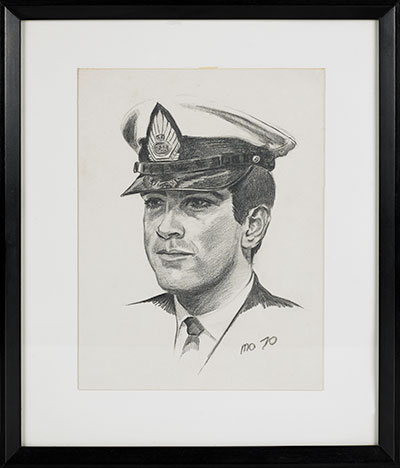
David Jacobson 1970

David Jacobson – a sketch from 1970  


The 2-day route check: My get-out-of-jail- card: 26-27 September 1970

Geoff and I – it was Geoff and David, now – were deadheading to Sydney on September 26th and there was now an opportunity to start to get to know each other a little and to discuss the day’s flying, the likely weather and other operational considerations, ahead of launching into it. He made no mention, whatsoever, of our last flight together. After flight planning, we located, checked and boarded the aircraft on the tarmac. The first leg to Canberra was flown by Geoff, as management pilots flew few personal sectors, themselves, due the dual workloads of admin and checking duties. His flying was impeccable, yet spirited and I recall thinking that I had a very hard act to follow, on my first return leg to Sydney.

After a couple of very pleasant hours in his company, I had relaxed just a little and that helped; I was content with the flight from Canberra, so far, as we began our descent into Sydney. Our arrival was straight in from a VOR radio beacon at Bindook, in the Blue Mountains, onto runway 07 (aligned nearly east – 068ºM), which had been reported as ‘damp‘. Regardless of the surface winds at Sydney Airport, I knew that we would have a likely prevailing tailwind of about 40kts (80km/hr), behind us. There was also the likelihood of ATC asking us for our best (highest) descent speed, to maintain separation from any faster, following jets. As pilot flying (PF), I planned and began the descent slightly earlier than I might have, normally:  It paid off.

We were maintaining our usual maximum indicated airspeed: 210kts IAS on the descent, when ATC called us and requested our ‘best-speed-as-long-as-possible‘, as they had one of the thenvery-new-and-very-large KLM B747 Jumbos behind us, following in sequence. Although normally much faster than us, ATC had already reduced that aircraft back to 250kts IAS, but the gap between us would still have been closing, with the 40kt difference in IAS.

Geoff  acknowledged the call and looked at me, studying my reaction. I was comfortable and quietly confident: we were already at maximum speed and I had some spare distance up my sleeve, to help facilitate our reduction in speed for the approach, when the time came. The 747 was ATC’s problem, not mine. However, I was still computing how I was going to manage the situation, given the tailwind and the extra groundspeed it created.

Normally, ATC would clear us down no lower than 3000ft at Glenfield NDB, 10nm on final, for the 07 straight-in instrument landing system – ILS. On this day, ATC very helpfully cleared us down to 2000ft at 10nm, which I knew would assist me in slowing the F27 from our present 210kts IAS back to 168kts (the maximum extension speed for the landing gear, our first decent drag-reducing device) in level flight at 2000ft, before intercepting the 3º ILS glideslope from beneath and then starting our final approach.

We levelled off at 2000ft and I capitalised on not having to decelerate whilst also descending. The F27 was a very ‘clean‘ (slippery) aircraft to slow down quickly, as it didn’t have a speedbrake, like the jets and modern turboprop aircraft. The laws of physics needed time, but I needed to be back to 168kts by the time we intercepted the ILS glideslope and started down again from 2000ft, at about 6nm, so I could use the added drag from the landing gear to decelerate further to our next target airspeed, 144kts, and start extending some flaps; and then to 126kts, so we could reduce further back to our final (runway) target threshold speed – TTS. To make things a little more challenging, the F27 had no groundspeed indication.

However, the aircraft needed further help to slow down. So I took a chance and made a somewhat contentious decision: At about 8nm out (without first seeking Geoff’s approval, nor forgetting for a second that he was the F27 Fleet manager), I closed both power levers (throttles), smoothly and fully, against the recommended and normal procedure of maintaining a minimum power setting of 40psi of torque. (This company requirement was stipulated to reduce propeller layshaft shuttling, causing excessive wear and tear, which occurred at lower power settings. But I had read a Company bulletin, noting that the aircraft manufacturers, Fokker, had published advice that flight crew could obtain some instant drag – only if necessary – without hurting the props – by fully closing the throttles completely and loading the layshafts the other way.) We were now a 20-tonne glider.

I felt, rather than saw Geoff’s eyebrows raise and his eyes narrow, but he said nothing. Neither did I: I was content, maintaining the 3º glideslope, perfectly: the airspeed was reducing well and I called for landing flap 40º and the landing checklist. ATC cleared us to land. The wind on runway 07 was actually a 15kt full crosswind, so still no headwind component to help reduce the groundspeed and there was the further consideration of the requirement for the judicious application of aileron and rudder inputs, to offset the L sideways drift, generated by the southerly crosswind, off Botany Bay. I never did advance the throttles from their idle stops.

The airspeed finally drifted back to our TTS of about 85kts, just prior to commencing the landing flare and I completed a full deadstick (idle-power), perfect touchdown on the windward (RH) main wheels first, then the LH main gear, finally lowering the nosewheel gently onto the damp runway. At 40kts IAS, I selected ground fine (0º pitch angle) on the propellers (a retarding effect similar to reverse thrust) and applied only slight pneumatic wheel braking. As we turned off the runway, I first heard and then saw the KLM 747 in full reverse thrust, raising much surface water as it rolled through after touching down only just behind us. We had honoured our commitment to ATC for ‘best-speed-as-long-as-possible‘ and the huge 747 hadn’t had to go around!

We swapped roles: Geoff taxied the aircraft after I obtained a taxy clearance to our parking bay on the TAA tarmac. As we taxied in, Geoff enquired, with a broad grin: “Are you the same guy I was with at Mangalore, last week?”  I replied, “I’m afraid so.”  He then offered a huge compliment: “I know a lot of captains who couldn’t have pulled that off!” I was just elated: Finally, I had scored some points on the board. We shut down and parted, briefly, as we prepared for the return sector to Canberra. The turnaround time was about 30 minutes and, after our traffic and engineering staff had cleared us, we started the engines again and taxied out for a departure to the south, on Sydney’s main north/south runway 16 (156ºM). We had a short dream run (no other traffic) to the take-off holding point and were cleared for take-off, before we even had to stop there. Geoff was again the pilot flying.

Geoff’s take-off and climb out over Botany Bay was perfectly normal: Until: I started to perform a normal geographic visual scan of every control, switch and instrument panel indication. On the LH overhead panel, above Geoff’s head, were 2 illuminated RED alternator failure warning lights. (‘Hang on, the alternators are completely separate animals: there cannot be a double alternator failure, can there?? – I was asking myself.  In the F27, the alternators supplied 208V AC to power the windscreen heat, wing and tail de-icing and engine nacelle and propeller anti-icing systems and some extra heating panels in the cockpit floor.)

Then I froze: My eyes had shifted to the 2 alternator switches – and BOTH were still in the OFF position. Then, the penny dropped: The alternators had NOT failed: They had not been turned ON at all, after we started the engines and neither of us picked that up because, in our haste to depart on time, we hadn’t completed the after-start checklist! Geoff had been distracted by something and I had failed to perform my primary support role as First Officer and remind him (something like, ‘Geoff, would you like an after-start checklist”.  ‘Oh GREAT WORK, Jacobson!’ After that glorious approach and landing, you’ve just blown all your points and gone back to square one!  But I couldn’t reflect or chastise myself any longer: Not now, anyway.) There was only one thing to do:

I spoke directly and clearly across the flight deck: “Geoff, I’m not sure we completed the after start checklist.”  He raised an eyebrow and asked, “Why do you say that?”  I just pointed to the panel above his head. The autopilot was by now flying the aircraft. He tilted his head and his eyes fell on the 2 RED alternator lights. Then they focused onto the switches. He turned back to me and said, very calmly, “Can I offer you a little piece of advice?”  (I had no idea what he was going to say, BUT, at this absolutely critical stage of my pathetic airline career, I certainly wasn’t about to say, “No, thank you.”)

It doesn’t matter when something goes wrong: What matters is what you do, when it does.”

With that, he returned his eyes to the offending panel and turned the 2 alternator switches ON. The 2 red lights extinguished. He turned back to his primary role – flying and managing the aircraft – and the matter was never mentioned again. Until now.

The rest of that sector went well, as did the following day. We flew from Sydney to Canberra again, then on to Essendon, Wynyard TAS and finally back to Essendon. Geoff debriefed me in his office, once again: very favorably and generously and I resumed my learning curve: one that hasn’t stopped, yet, even though I am no longer flying actively.


David’s logbook entries for September 1970

Captain Geoff Lushey gave me both the opportunity to save my career from oblivion and that best single piece of advice, I ever received. We went on to fly the DC-9 and the B727 together. He subsequently taught me many more things about what is and what is not a fair thing to do, in a jet. More than any other captain, he challenged me to keep improving, every single time we went flying together, without ever turning our operation into a competition.

I have been reminded recently, by another highly respected colleague, how Geoff always made his first officers feel that they were part of a team. In this regard, he was way ahead of his time in introducing cockpit resource management (CRM) principles that are part of standard aircrew training, today. I know many of us later modeled much of our own operation, as captains ourselves, from the examples he demonstrated. It almost goes without saying that his own personal flying was impeccable. He could fly a fully inverted instrument circuit, in the DC-9-30 simulator (with the motion turned off, to protect the sim), all within command instrument rating control tolerances! It took me all my instrument flying skill to perform the same manoeuvre, upright!


Captain Geoffrey W Lushey DFM

Of course, long retired now, Captain Geoff Lushey remains, to this day, the single best pilot and finest airman with whom I ever had the privilege and pleasure to fly. There were many other inspirational pilots, of course, but Geoff was the stand-out.

It is no overstatement to say that I owe him my career and I am grateful to have had still, all these years later, the opportunity to say so: and for Geoff to have been able to read and endorse my version of these events!


Wishing you many safe landings


Captain David M Jacobson FRAeS MAP


Would you care to experience that unsurpassed sense of accomplishment, derived from executing consistently beautiful landings, more often?

For starters, Download the FREE Jacobson Flare LITE, our no fuss/no frills introduction. Here we demonstrate, step by step, the application of the Jacobson Flare on a typical grass airstrip at Porepunkah, YPOK.


We invite you to browse the consistently positive comments on our Testimonials page. Many pilots, of all levels of experience, have downloaded our Apps. Read about their own experiences with the Jacobson Flare technique and the App.

Then download the COMPLETE Jacobson Flare app – for iOS. You’re already possibly paying $300+/hour to hire an aeroplane: You’ll recover the cost of the app, in just ONE LESS-NEEDED CIRCUIT. Moreover, you’ll have an invaluable reference tool, throughout your entire life in aviation.

Download the COMPLETE Jacobson Flare App for iOS devices now.


We invite you, also, to review our new, FREE companion app,

offering a convenient way of staying abreast of our latest blogs.


Download the Jacobson Flare NEWS App for iOS devices now.

Two pilots in a cow suit: Mastering the Approach_JF-ai podcast

We revisit this earlier post and introduce a couple of friendly AI ‘aces’, whom we’ve nicknamed ‘Jay Bird’ Jaime & ‘Fearless’ Frank.

Simply select the Play button below, for a 5-minute JFai podcast summary of this post

Of course, if you’d like some further elaboration, just scroll down.


Two pilots dressed for a fancy-dress party, in a cow-suit .. or .. What controls what, on final?

Do you know why some pilots still try to fly a POWERED final approach using the SECONDARY effects of the PRIMARY flight controls?

Neither do we!

We shall discuss glide approaches, later in this article. But arguing about what controls what, on a final approach – when variable power or thrust is available – has occupied far too much time and confused far too many pilots, for over 100 years. It is vital to the understanding of HOW to aim the approach, accurately, yet the argument still rages. It shouldn’t.

Let me conceive a comical image: Imagine how ridiculous-looking, ungainly and haphazard would be the sight of two pilots heading out to a fancy-dress party, dressed in a COW SUIT.

The guy in the front would, presumably, be responsible for finding their way to the venue and steering the ‘beast’, while the poor individual providing the hindquarters would essentially maintain a stooped-over profile and act as the limiting factor on their speed, neither pushing too hard, nor allowing the front half to drag him/her along, too fast.

Now, please hold these thoughts for a minute or two.

On a normal, powered, manually-flown approach, the pilot has one hand holding the control column and the other hand on the throttle and, together with the brain of  the pilot, the complete approach is coordinated. But what controls the flight path along the extended runway centreline? And what controls the airspeed? Pilots have argued over this, for decades.

It is instructive, therefore, to consider how an ‘artificially-flown’ approach is constructed.
In an airliner, conducting an ‘auto-coupled instrument approach’, the autopilot and autothrottle systems perform the same functions, respectively, yet quite independently from each other, using only the primary effects of controls.

The autopilot controls the flight path along the electronic extended runway centreline path and the 3º glideslope, while the autothrottle maintains the selected approach airspeed.

Now, these two ‘black boxes’ under the cockpit floor are completely unaware of each other’s existence. It is the automated flight control system (AFCS) that coordinates their inputs (along with many others) to control both the approach path and airspeed and simulates the manually-flown approach with impeccable accuracy and stability.

Moreover, because the aircraft is not pitching up and down, the stability of this ‘PATH’ descent also facilitates the application of the unique Jacobson Flare visual fix. It is an accurate, far straighter flight path than the ‘conventional roller’ coaster path of varying amplitude and runway threshold crossing heights, resulting from pitching to maintain approach airspeed. A handy side-effect is enhanced passenger comfort, especially in large aircraft with inherently great inertia and a limited supply of  airsickness bags!

The stability of this PATH descent also facilitates the application of the unique Jacobson Flare visual fix: No roller coaster path, here.

There are two occasions, however, when it is appropriate to control airspeed with the SECONDARY effects of the elevators:

On take-off and in the subsequent climb, for example, with take-off power or climb power set, the pilot must utilise the elevators to control the airspeed. There is no alternative.

The second occasion is on approach, IF the power output is constant (or failed, partially or completely). It is necessary, then, to control airspeed with the elevators (along with refining the approach path angle, through judicious tracking and deployment of landing flaps). This is generally a training manoeuvre, such as when practising a NON-NORMAL procedure, such as a forced landing. It is a compromise – inaccurate and results in an oscillating, inconsistent, ‘rollercoaster’ path.

Sailplanes (gliders) are normally flown this way; for without power, these aircraft are always descending through a parcel of air which, hopefully, is itself rising faster than the actual descent rate of the sailplane within it (that is, a thermal).

Using the secondary effects of the flight controls. ‘Elevators controlling airspeed’, with the nebulous concept of ‘power/thrust facilitating rate of descent is valid only when power/thrust is fixed (or lost, entirely) and is ineffective on heavier and/or faster airplanes. A roller coaster flight path is the inevitable result, leading to unstable approaches. This is one of several major reasons for inconsistent and poor-quality landings.

The Speed Descent

The costs are immense, in terms of time, cost, pilot stress and aircraft damage. Many instructors insist that airspeed is controlled with the elevators and the vertical rate of descent is controlled with power. This is misconceived. The use of an increase in power certainly does facilitate descent flight at a reduced path angle, for a given airspeed: However, it is the reduced path angle that reduces the rate of descent, not the power. This particular point has been long-lost in the translation, over the last 100 years.

The rate of descent on an approach is, simply, the result of two variables: the flight path angle and the aircraft’s ground speed.

Now, why would anyone want to apply the secondary effects of controls, rather than the primary effects, IF THEY DIDN’T HAVE TO, when flying the most precise manoeuvre that most pilots ever need to master? Not to mention making so many corrections of corrections. Absolutely NOTHING remains stable: Not the power setting, the elevator inputs, the path angle, airspeed, vertical speed or aircraft trim.

Another critical issue is to consider the two common errors that student pilots (and licensed ones also) who have been taught this inappropriate method, make frequently:
1. High and fast on final approach; and/or
2. Low and slow.

In each case. the initial response for a pilot trained to think that the elevators control airspeed, will COMPOUND both problems, because his or her priority will be airspeed, not flight path.

The pilot who is HIGH and FAST will pitch UP making things worse and the pilot who is LOW and SLOW will pitch DOWN -the LAST things the pilot should be doing to resolve each of these errors!

The next major issue is that the roller coaster flight path ensures that the threshold crossing height of the aircraft will be totally inconsistent, making landing judgment quite haphazard, with no guidance through the flare. Then, there is the significant issue of when to initiate the flare.

And because of the very ‘flat’ standard approach angle of 3 degrees, ALL vertical errors in height judgment compound 20-times, one way or the other, along the runway: Long if high, short if the guess is low, compared with the optimum flare height.

How can an instructor demonstrate the flare height as being ‘about here‘ or ‘about now’, when the picture is different, every single time?

As if all of that is not enough of a problem, the situation worsens at a most critical phase: the flare point. A pilot, incorrectly pitching the airplane with the elevators to control AIRSPEED, now needs to transfer the use the elevators to pitch the aircraft to control the FLIGHT PATH ANGLE, just as the flare is about to be initiated.

What a ridiculous moment to completely change the flight path control philosophy! It defies all logic.

Most approaches and landings are flown in powered airplanes, where the power output is variable and reliable: Therefore, the afore-mentioned PRIMARY effects of the controls should be applied: The constant approach path angle is maintained with the elevators, by aiming the pilot’s eyes at a suitable aim point and the throttle is utilised to vary the power, slightly, to maintain the selected approach airspeed (IAS) through each flap configuration and wind change.

There is, of course, no need to change your flight control philosophy, as the landing flare is initiated.

The Path Descent

None of this is new to generations of military and airline pilots, but it often meets ignorant and stubborn resistance, by some misinformed general aviation (GA) flight instructors and, sadly, their unsuspecting students. Frequently, these same instructors contradict themselves, making no sense in teaching the speed technique to VFR students in light airplanes and then introducing the path descent when they progress to heavier and faster aircraft and IFR. After all, the airplane doesn’t know the difference between IFR and VFR! But it does know the difference between a powered and a glide approach and that is the arbiter.

OK, let’s return to where we started: Two pilots dressed for a fancy-dress party, in a cow-suit …

From the foregoing, it should become clear that flying a NORMAL, powered approach with a ‘SPEED’ descent, that is, with the secondary effect of the elevators controlling airspeed and power supposedly controlling the rate of descent/path angle, is just as silly as having the guy in the front of the cow-suit, who can see where to steer, worrying only about how fast they are going; and the guy down the back, who cannot see a damn thing, trying to find the party.

So, the comical and ridiculous cow-suit analogy is quite relevant.

There are many more advantages in flying an accurate ‘PATH’ descent: To learn more on this, please review FAQ #5, in https://www.jacobsonflare.com/our-most-frequently-asked-landing-questions/ . The Jacobson Flare App, of course,  expands at length, also, on this critical aspect.


Captain David M Jacobson


Wishing you many safe landings


Captain David M Jacobson FRAeS MAP


Would you care to experience that unsurpassed sense of accomplishment, derived from executing consistently beautiful landings, more often?

For starters, Download the FREE Jacobson Flare LITE, our no fuss/no frills introduction. Here we demonstrate, step by step, the application of the Jacobson Flare on a typical grass airstrip at Porepunkah, YPOK.


We invite you to browse the consistently positive comments on our Testimonials page. Many pilots, of all levels of experience, have downloaded our Apps. Read about their own experiences with the Jacobson Flare technique and the App.

Then download the COMPLETE Jacobson Flare app – for iOS. You’re already possibly paying $300+/hour to hire an aeroplane: You’ll recover the cost of the app, in just ONE LESS-NEEDED CIRCUIT. Moreover, you’ll have an invaluable reference tool, throughout your entire life in aviation.

Download the COMPLETE Jacobson Flare App for iOS devices now.


We invite you, also, to review our new, FREE companion app,

offering a convenient way of staying abreast of our latest blogs.


Download the Jacobson Flare NEWS App for iOS devices now.

Landings De-mystified: Jacobson Flare-AI takes a look

Even a century on, landing an aircraft is still considered by most as an art form. Can it be de-mystified?Landings De-mystified

The landing was something to be mastered through experience, intuition, and a fair bit of guesswork. But what if landing could be de-mystified from a stressful guessing game into a precise, repeatable skill, based on a universal, quantifiable and unassailable framework? Enter the Jacobson Flare, a revolutionary technique that leverages visual geometry and physics to eliminate uncertainty and deliver consistently smooth landings.

The Century-Old Problem: Guessing Height

Traditionally, pilots have relied on their perception and judgment to execute the landing flare—the critical moment just before touchdown when the nose is pulled up to soften the landing. This approach is inherently risky and inconsistent. The mathematics behind the glide path reveal a staggering one-to-twenty ratio: a one-foot vertical misjudgment translates into a twenty-foot error along the runway.

This means a tiny mistake in height estimation can result in overshooting the landing zone or a premature, jarring touchdown. Many flight schools still teach the “speed descent” method, which uses the elevators to control speed and engine power to manage descent rate. This creates an unstable, roller-coaster-like flight path, making precision nearly impossible.

Flipping the Approach: Path Descent and Stability

Finding a key to solving this problem is to reverse the conventional wisdom. Instead of controlling speed with the elevators, pilots must use this primary flight control to aim their eyes at a specific point on the runway, and lock in a stable three-degree glide path. Engine power is then used to maintain speed. This concept is certainly not new: airlines and defence forces have embraced it for years.

However, many civil flight training organisations still cling to their the dangerous mantra, ‘We’ve always done it this way’ The stable path approach is the foundation for the Jacobson Flare, ensuring the aircraft is perfectly positioned for the next steps.

“Fortuitously, my original Assistant/Chief Flying Instructor, Jim Noonan, first introduced me to this method back in 1965, at Civil Flying School, YMMB Moorabbin VIC. I utilised this method on every aircraft I ever flew, including sailplanes. Yes, sailplanes – gliders – still using the elevators to ‘fly my eyes’ towards the initial aim point 1 and the ‘air-brakes’ to control the airspeed. You see an aircraft simply reacts to an acceleration of a deceleration. Naturally, it cannot discern between reducing power, or increasing drag. And vice versa.

I felt vindicated, as the first two elements of the approach and landing started to become de-mystified for me – Where to aim and how to aim. Instinctively,  even at just 17 years of age, I had wanted to fly this way, but my first instructors wouldn’t permit me. They (and I) simply didn’t have the experience on much larger and faster airplanes to understand the requirements for a stable approach; or to realise that aiming with the elevators and controlling airspeed with power was equally relevant to light aircraft, when on powered approaches.”

The Geometry of the Flare: Erasing Guesswork

David Jacobson, a former Qantas captain with 55 years and 24,500 hours of flight and flight training experience, researched and introduced a game-changing concept: using the runway as a visible, calibrated ruler. He was inspired, as a seventeen-year-old, by the World War Two RAF 617 Sqn ‘Dambusters’, who used intersecting spotlight beams to provide two position lines, creating an accurate visual fix for the low-level delivery of 6-ton ‘skipping’ bombs from just 60 ft over still water at night. They also developed a simple Y-shaped bomb sight, again based on triangulation, to refine the bomb-aimers’ release point. Their targets were several large dams in Western Germany, which were heavily protected by steel nets suspended in the water – to eliminate the use of mines or torpedoes. In addition, anti-aircraft fire was a grave risk.  The Jacobson Flare applies similar and simple applied triangulation, using the airplane’s own cockpit geometry.

For a start, the first position line is the pilot’s standard -3º downward line of sight, aimed at a specific pre-calculated point on the runway, suitable for the size of the airplane and called aim point 1 (AP1). The bigger the airplane, the deeper along the runway this point must be, to assure proper threshold height clearance of the main landing gear – MLG, this being the lowest part of the airplane while on approach to land.

The second position line is an additional line of sight from the pilot’s eye, this time as a tangent, just glancing down the fixed lower visual cut-off angle of the airplane’s glareshield or dashboard, which blocks the pilot’s view over the nose, from the seat. This angle forms part of the design of the airplane cockpit. In older generations of aircraft, with analogue instrumentation, this angle is commonly of the order of -13º. Modern airplanes with digital instrumentation (known as EFIS – electronic flight instrumentation systems) tend to have lower visual angles of approximately 20º.

As the pilot flies down the ‘locked-in’ -3º glide path, the dashboard eventually eclipses a second longitudinal point on the runway, short of the aim point.  This called the flare cut-off point – FCoP. This point is pre-calculated (just once for each airplane type) from the manufacturer’s-recommended or operator-desired flare commencement height.

When the airplane glare shield advances along the runway, while the pilot continues to aim at aim point 1, the glareshield will ultimately overtake and eclipse  the FCoP, creating a definitive visual fix. This signals the exact moment to begin the flare, eliminating the need for vertical height estimation, and it’s inherent, long-overlooked mathematical 20:1 error . The whole process is quantifiable, mathematical, and clearly visible from the cockpit and absolutely assists in de-mystifying the landing manoeuvre.

Five Steps to Perfect Landings

Jacobson breaks the landing process into five sequential steps, replacing vague instructions with a universal system:

Where to Aim: Identifying the pre-calculated precise aim point 1 on the runway; Note: a point, not a vague area;

How to Aim: Flying a stable glide path using the elevators to aim your eyes and the throttle to control the airspeed.

When to Flare: Responding to the visual eclipse of the dashboard/glareshield over the flare cutoff point;

How Much to Flare: Adjusting pitch to focus on a new, second aim point, usually at the upwind threshold of the runway; and

How Fast to Flare: Execute the flare over four seconds for a smooth, exponential curve, while simultaneously coordinating an appropriate gentle reduction in power or thrust.

If any of these parameters are not met, the framework prioritises a go-around as a logical safety decision, rather than a last-minute panic manoeuvre.

The Four-Second Flare: Bending the Flight Path

Conventionally, the timing of the flare is crucial was never measured. By counting evenly to four seconds while easing the nose up, and commencing to reduce power or thrust, the pilot creates a perfect exponential curve in the vertical flight path. In the first second, the descent rate may be rapid, but as the pitch increases through seconds two and three, lift is generated, flattening the descent. By the fourth second, the wheels are dropping at just a few inches per second, easing to a gentle kiss, at touchdown. The maneuver is guided entirely by the pilot’s shifting visual aim point, ensuring safety and precision. Just as when throwing a ball, the aircraft politely follows the pilots line of sight.

Universal Precision: For Every Airplane

A common misconception is that this level of precision is only suitable for large commercial jets. In reality, the Jacobson Flare is universally applicable. Whether you’re a student pilot in a small Cessna or a seasoned captain landing an Airbus A380, the same mathematical principles apply. For student pilots, the technique reduces training time and costs by providing a repeatable relationship instead of a guessing game. For airline professionals, it enhances safety and consistency. For passengers, it means smoother, more comfortable landings every time. Finally, the landing is de-mystified.

The Elegant Simplicity of the Jacobson Flare

One pilot described the Jacobson Flare beautifully, as having “the elegant simplicity of the safety pin.” Following thirty-five years of aerodynamic research, Jacobson distilled a century-old problem into a brilliantly simple, universal and unassailable visual technique.

So, the next time you watch a plane approach the runway, visualise those intersecting lines, the eclipsing dashboard, and the four-second exponential curve through the flare. Landing is no longer a matter of feeling for the ground, while you’re wishing and hoping—it’s a precise execution of mathematical geometry. And the entire flight profile is fully visible to the pilot, like a real-world head-up display.

Final Thoughts

The Jacobson Flare represents a paradigm shift in aviation, turning landings into a safe and consistent skill, rather than either an art or a science. By leveraging visual geometry and physics, pilots can achieve unmatched precision, safety, consistency, confidence and comfort. Whether you’re in the cockpit or the passenger seat, understanding this technique changes your perspective on flying forever.


Wishing you many safe landings


Captain David M Jacobson FRAeS MAP


Would you care to experience that unsurpassed sense of accomplishment, derived from executing consistently beautiful landings, more often?

For starters, Download the FREE Jacobson Flare LITE pdf , our no fuss/no frills introduction. Here we demonstrate, step by step, the application of the Jacobson Flare on a typical grass airstrip at Porepunkah, YPOK.


We invite you to browse the consistently positive comments on our Testimonials page. Many pilots, of all levels of experience, have downloaded our Apps. Read about their own experiences with the Jacobson Flare technique and the App.

Then download the complete Jacobson Flare ESSENTIAL App – for iOS. You’re already possibly paying $300+/hour to hire an aeroplane: You’ll recover the cost of the app, in just ONE LESS-NEEDED CIRCUIT. Moreover, you’ll have an invaluable reference tool, throughout your entire life in aviation.


Download the Jacobson Flare ESSENTIAL App for iOS devices now.


We invite you, also, to review our new, FREE companion app,

offering a convenient way of staying abreast of our latest blogs.


Download the Jacobson Flare NEWS App for iOS devices now.

JF App button

Are you struggling towards first solo? Part 3 of 3. This may help …

Revolutionising Aircraft Landing Techniques: The Advantages of the The Jacobson Flare:

The Jacobson Flare is a revolutionary, innovative and practical approach to aircraft landing training that transforms the execution of this critical manoeuvre. Traditionally, landing an airplane has been considered an art form, requiring years of experience to master.

However, the Jacobson Flare redefines this perception by introducing a logical, structured, and universally applicable technique. At once, this simplifies the landing process for pilots of all skill levels and aircraft types.

The heart of the matter

At its core, the Jacobson Flare provides a clear and quantifiable method for performing the landing flare manoeuvre. The technique revolves around the concept of a “longitudinal flare cutoff point” on the runway, which serves as a visual reference for the pilot.

Pilots can now determine the precise moment to initiate the flare, reducing reliance on subjective judgment, perception, and experience.This approach transforms landing into a skill that can be taught and learned systematically, enhancing the confidence of both novice and experienced pilots.

The advantages

One of the key advantages of the Jacobson Flare is its ability to minimise the impact of variable factors that traditionally complicate the landing process. For instance, runway slopes, widths, flap settings, and approach angles often create visual illusions that can affect a pilot’s perception of height and distance. The Jacobson Flare mitigates these challenges by providing a fixed visual reference—the flare cutoff point—that remains consistent regardless of these variables. This ensures a predictable and accurate landing, even in diverse conditions.

The technique also offers significant benefits in terms of standardisation and training. By providing a universal method for landing, the Jacobson Flare facilitates consistent practices across aviation organisations. This standardisation is particularly valuable in assessing evidence-based competency standards, which are increasingly vital in modern aviation.

Furthermore, the technique simplifies both elementary and advanced pilot training, reducing the time and costs associated with developing landing skills. Pilots can quickly adapt the method to different aircraft types, making it a portable and versatile tool throughout their careers.

Experienced pilots also benefit from the Jacobson Flare, especially when returning to flying after a period of leave or non-flying duties. The visual flare fix complements their existing skills, enabling them to achieve greater consistency in their landings. This consistency has practical implications, such as minimising runway occupancy times, optimising traffic flow, and reducing wear and tear on aircraft tires, brakes, and undercarriages.  These improvements contribute to enhanced operational efficiency and reduced maintenance costs.

The safety benefits

A380 landings with The Jacobson Flare

A380 landings with The Jacobson Flare

Safety is another critical advantage of the Jacobson Flare. By eliminating the need for guesswork and relying on a visible and predictable approach, the technique significantly reduces the likelihood of landing accidents. The risk of damage or loss of aircraft, or the injury (or worse) to their pilots and passengers, and the ensuing insurance claims, can be minimised. Pilots can execute the entire approach and landing manoeuvre with greater confidence and precision, enhancing overall flight safety.

Since its introduction in 1985, the Jacobson Flare has been adopted by hundreds of civil and military pilots across various aircraft types, from sailplanes and light airplanes to large jet transports. Its universal application and adaptability make it a valuable tool for the aviation industry. By addressing the differences between aircraft while embracing their similarities, the Jacobson Flare provides a comprehensive yet practical system of flight training that meets diverse operational requirements.

In conclusion

The Jacobson Flare is a groundbreaking technique that has redefined the art of landing an airplane. Its logical, consistent, and universal approach simplifies training, enhances safety, and improves operational efficiency. By providing a clear visual guide for pilots, the Jacobson Flare ensures predictable and precise landings, making it an indispensable tool for modern aviation. Its widespread adoption is a testament to its effectiveness and the significant benefits it offers to pilots and the industry as a whole.

Wishing you many safe landings


Captain David M Jacobson FRAeS MAP


Would you care to experience that unsurpassed sense of accomplishment, derived from executing consistently beautiful landings, more often?

For starters, Download the FREE Jacobson Flare LITE pdf , our no fuss/no frills introduction. Here we demonstrate, step by step, the application of the Jacobson Flare on a typical grass airstrip at Porepunkah, YPOK.


We invite you to browse the consistently positive comments on our Testimonials page. Many pilots, of all levels of experience, have downloaded our Apps. Read about their own experiences with the Jacobson Flare technique and the App.

Then download the complete Jacobson Flare ESSENTIAL App – for iOS. You’re already possibly paying $300+/hour to hire an aeroplane: You’ll recover the cost of the app, in just ONE LESS-NEEDED CIRCUIT. Moreover, you’ll have an invaluable reference tool, throughout your entire life in aviation.


Download the Jacobson Flare ESSENTIAL App for iOS devices now.


We invite you, also, to review our new, FREE companion app,

offering a convenient way of staying abreast of our latest blogs.


Download the Jacobson Flare NEWS App for iOS devices now.

Are you struggling towards first solo? Part 2 of 3. This may be why…

Part 1 of this series discussed some of the issues with conventional landing training. This second part looks at what I did about improving the situation, for students and their instructors.

How it all began

The origins of the Jacobson Flare date back to 1965. When just a 17-year-old young student pilot, training at YMMB (Moorabbin, Victoria, Australia), I started questioning the traditional methods of landing an aircraft, taught by my first flight instructors.

Over 60 years later, I can still recall trying not to be a smart-ass, but being dismayed by having to rely on nothing better than trial-and-error practices. These, I learned, have been passed down, unchallenged since the end of World War I in 1918, by generations of flight instructors.

To this day, I still find it perplexing that pilots are taught what to do to land an aircraft but not how to do it, with any precision or consistency.

The Problems

Initially, I was taught to control airspeed by pitching the airplane with the elevators, while attempting to use power to control the rate of descent. While clearly necessary for a glide approach, it made no sense to me to use the secondary effects of both the elevator and throttle controls to fly the airplane, for a normal powered approach. For me, this generally led to a roller-coaster ride down final approach, with quite inconsistent landing results. Not surprising, with a pitch correction needing a power correction, followed by another pitch correction and so on. There is no stability.

The landing is the most precise manoeuvre that most pilots are ever required to execute. Yet then and later, my serious questions on ‘when to flare‘ were neither answered nor quantified. Most manuals regurgitate the old myths and misinformation.

Getting the ‘hang’ of the landing flare from a combination of guesswork, the ‘look‘, the ‘feel’, repetition, and luck has never made sense to me, whatsoever. I soloed at about 10 hours, but the initial methods that I was taught never sat well with me. They were and they remain non-intuitive and simply unintelligent.

Thankfully, a fine ex-RAF instructor, Jim Noonan, launched my CPL night flying training. In that initial process, he taught me how to aim my eyes at an appropriate aim point by pitching the airplane with the elevators and controlling airspeed with power. What a relief!

I wanted to do this, instinctively, from the start. Later, I learned that this is the technique taught by the airlines, our defence forces, and the more enlightened flying schools.

The Inspiration

My original inspiration for the Jacobson Flare came from an unlikely source, the celebrated 1956 British film ‘The Dam Busters’. The movie depicts the 1943 RAF 617 Squadron’s celebrated application of triangulation: Two precisely aimed converging spotlights and a simple, Y-shaped bomb sight resolved the problems of a low-flying attack over water, at night. As a then 9-year-old, I was enthralled.

One day in 1965, it suddenly clicked: My eye path to the aim point for the B23 Musketeer was a position line, as in navigation. A second position line, such as another one over the nose of the airplane to a point on the runway centreline, short of the aim point, would surely provide a visual fix for the flare point. This had to be better than relying on an educated guess of vertical flare height, which (again, I learned later) is flawed mathematically, to the power of +/- 20 times, along the runway, due to the shallow 3-degree path angle.

The concept of simple triangulation captured my imagination, but, of course, I had minimal flight experience back then. Certainly not enough to dream that my idea might actually work, let alone be universally adaptable to almost any airplane.

Handling the Hurdles

I was also yet to learn that, sadly, some key aviation figures, organisations, even universities are sometimes apathetic. So are airlines and airplane manufacturers. I believe that the approach and landing is the most neglected topic in the flight training syllabus, and the silence on this subject is deafening.

We’ve always done it this way’ or “No, thanks” are not arguments or reasons. They are simply lame excuses to avoid rational thinking.

Thankfully, I’ve succeeded in reaching thousands of pilots directly.

My professional career spanned five decades: Starting as a flight instructor in general aviation, I progressed through an exciting and  distinguished career with Trans-Australia Airlines (-TAA, later Australian Airlines -AAL). Flying various aircraft, including the F27, DC-9-30, and B727-100/-200, as a First Officer, I achieved commands later, on the F27, DC-9-30, and B737-300/-400. Following the 1992 merger of AAL with QANTAS Airways, I flew B737-300/-400/-800 aircraft as a Training Captain.

However, it was an earlier incident in 1978 that profoundly influenced my thinking about landing techniques. During a routine flight as a First Officer on a B727-100, a visual illusion at night caused me to misjudge the flare height, resulting in a firm landing. This experience underscored the need for a more precise and reliable method of landing.

Research and Development

By 1983, I was also instructing at the RAAF Point Cook Flying Club, where I rediscovered my passion for elementary flying training. In 1986, after I was appointed by TAA as a DC-9 Training Captain while still instructing concurrently on light aircraft. Then and for many years after, the crippling issues with conventional landing training became clearly apparent. Primarily, they are universal for any airplane type, from sailplanes to A380s and the industry is none the wiser.

It was at Point Cook in 1985 that my 1965 inspiration from ‘The Dam Busters’ resurfaced. This led to my serious research and development of a comprehensive approach and landing training technique, later to become known as the ‘Jacobson Flare.’

In November 1987, I presented my initial findings in a paper titled ‘Where to Flare?’ at the Australian Aviation Symposium in Canberra. This new, innovative technique was based on ‘simple, unassailable aerodynamic logic‘ and the use of triangulation to define a virtual eye path to touchdown. Unlike traditional methods, my innovative new technique eliminated the need to judge the height of an invisible side of a triangle, which varies for different aircraft types. Instead, it relies on visible and quantifiable cues, making the flare point predictable, consistent, and adaptable to virtually any aircraft that flares.

One of my airline colleagues, initially sceptical, stated, “This has the elegant simplicity of the safety pin.”

Moreover, many more pilots have described my technique as ‘quantifying what pilots have long been trying to do, by guesswork and repetition.’

The Jacobson Flare App for iOS

In 2012, I collaborated with Jamie Durrant, Director of Essentials Magazine and Multimedia, to create a new chapter in the Jacobson Flare story. Together, we developed the Jacobson Flare App for iOS, which was released in June 2014. The app provides a step-by-step guide to implementing the technique. The Jacobson Flare is easily accessible to pilots worldwide.

The app is praised for its design, functionality, and presentation. It has earned respect from thousands of pilots in over 80 countries. Recognised by industry leaders, the Jacobson Flare Pty Ltd was shortlisted as a finalist for the prestigious Innovation Awards of Aerospace Australia at the Avalon Airshow in 2015.

For the full stories behind this post, I invite you to click the following links: Captain DM Jacobson and The Jacobson Flare Story.

And please, do stay tuned for Part 3, which will highlight the unique advantages of the Jacobson Flare.


Wishing you many safe landings


Captain David M Jacobson FRAeS MAP


Would you care to experience ,more often, that unsurpassed sense of accomplishment, derived from executing consistently beautiful landings?

For starters, Download the FREE Jacobson Flare LITE pdf , our no fuss/no frills introduction. Here we demonstrate, step by step, the application of the Jacobson Flare on a typical grass airstrip at Porepunkah, YPOK.


We invite you to browse the consistently positive comments on our Testimonials page. Many pilots, of all levels of experience, have downloaded our Apps. Read about their own experiences with the Jacobson Flare technique and the App.

Then download the complete Jacobson Flare ESSENTIAL App – for iOS. You’re already possibly paying $300+/hour to hire an aeroplane: You’ll recover the cost of the app, in just ONE LESS-NEEDED CIRCUIT. Moreover, you’ll have an invaluable reference tool, throughout your entire life in aviation.


Download the Jacobson Flare ESSENTIAL App for iOS devices now.


We invite you, also, to review our new, FREE companion app,

offering a convenient way of staying abreast of our latest blogs.


Download the Jacobson Flare NEWS App for iOS devices now.