
Author: David Jacobson

To learn something new, we may have to un-learn something old …

“To learn something new, we may have to un-learn something old …”

I was reminded of this intriguing thought, in a recent conversation with my chiropractor. I am often asked why I thought it necessary to ‘bother‘ trying to turn the landing manoeuvre away from being regarded as a ‘mystical art’, where most pilots, world-wide, have been indoctrinated to believe it can be mastered only by repetition and experience; where judgment, competency and confidence are achieved at some indeterminate time.

For a start, I regard the landing as a skill – not an art or a science. But to explore this a little more, I was drawn to looking at how the rest of the flight training syllabus -other than the landing – has been taught, historically.

Think back to the time when it was proven that the Earth was round and not flat. The concept was nearly impossible for the majority of those alive to accept.  This is because once a person learns something, it is almost impossible to tell them that it is actually different. This is The Law of Primacy – (Thorndike, Professor Edward L. Teachers College, Columbia University, NY. circa 1932).

We often tend to believe implicitly what we are first taught, on any given subject, creating a strong, almost unshakeable, impression – it becomes a ‘fact’; and if this ‘fact’ is, in fact, not factual – that is, not correct in the first place, it can often be very difficult to un-learn.

Some people exhibit belief-bias effects. They are biased to to accept arguments that attempt to deduce a conclusion they believe to be true and to reject arguments that attempt to deduce a conclusion they believe to be false. This somewhat similar to the term ‘perseveration‘.

In particular, such biases may tend to make people’s beliefs impervious to rational arguments.’

We may need to be reminded of what we think we know, already and review it; perhaps even un-learn it, to clear some  headspace for something better.

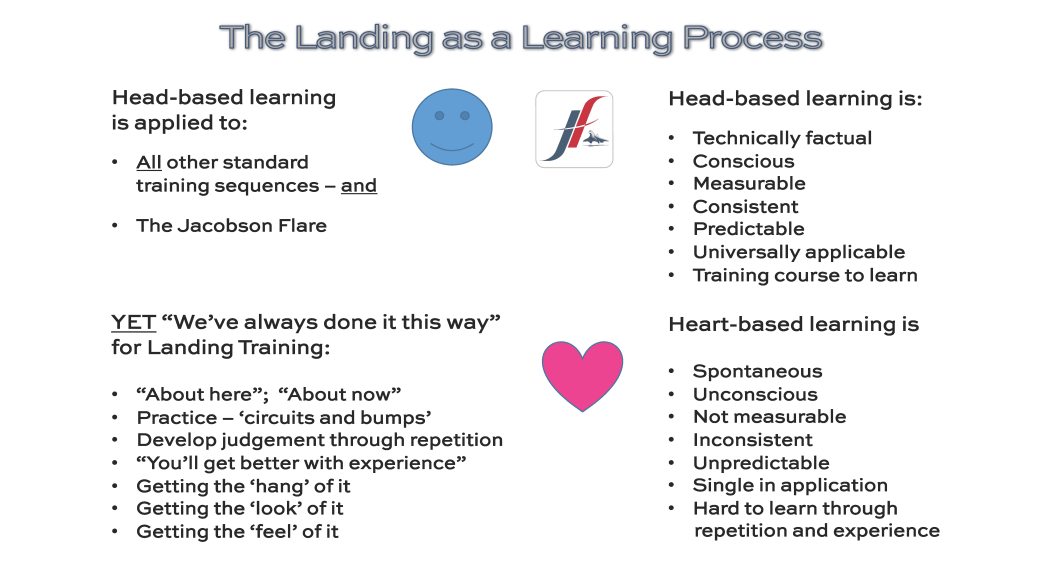
I am indebted to the School for Social Entrepreneurs Australia for the succinct ‘Change as a Learning Process’, referenced from their ‘INTRODUCTION TO ACTIVE LEARNING’ participant workbook (page 3, v.2.0 2015):

Clear distinctions are drawn here, between head- and heart-based learning processes.

It is well understood that pilot training is generally based on head-based learning, however there is a ‘stand-out’ exception.

Since the earliest days of aviation, head-based or technically definable training processes have been applied to just about all flight training sequences, but not the landing manoeuvre.
TJF TLaaLP 160731

It is fascinating to note how the most precise manoeuvre that most pilots have to master has been relegated to esoteric, yet meaningless expressions and personal opinions, such as, “about here”, “about now”, and getting the ‘hang’ or the ’sight picture’ or the ‘feel’ of it. Not a very logical, precise or standardised method of instruction, is it?

That is why the Jacobson Flare was developed, in 1987. Without a technically factual explanation, pilots have had no hope of predictable, consistent and universally quantifiable landings. The proven and potential cost savings are immense. Consider:

  • Reductions in training time;
  • Reduced wear and tear on pilot and machine;
  • Greatly improved confidence and competency at all levels;
  • Reductions in airport runway occupancy times; and
  • Vast improvement in flight safety.

Isn’t it about time that the industry re-considered the statement, “We’ve always done it this way”? We no longer ‘swing the prop‘ (or fan blades) on modern airplanes; neither do we navigate by the stars. Everything else in aviation has developed.

IF you are seeking some fresh information on landing technique, different from the non-quantifiable and inconsistent results you may have experienced;

IF perhaps you’ve now realised by now that you were never actually taught HOW to land, but just WHAT to do, when landing;

IF you have always felt that there had to be a better way to teach, to understand and to learn HOW to land an airplane, WITHOUT having to ‘getting the hang of it’, on every successive airplane conversion: THEN …

You are invited to view the wealth of information on this website: www.jacobsonflare.com/


Wishing you many safe landings


Captain David M Jacobson FRAeS MAP


Would you care to experience that unsurpassed sense of accomplishment, derived from executing consistently beautiful landings, more often?

For starters, Download the FREE Jacobson Flare LITE, our no fuss/no frills introduction. Here we demonstrate, step by step, the application of the Jacobson Flare on a typical grass airstrip at Porepunkah, YPOK.


We invite you to browse the consistently positive comments on our Testimonials page. Many pilots, of all levels of experience, have downloaded our Apps. Read about their own experiences with the Jacobson Flare technique and the App.

Then download the COMPLETE Jacobson Flare app – for iOS. You’re already possibly paying $300+/hour to hire an aeroplane: You’ll recover the cost of the app, in just ONE LESS-NEEDED CIRCUIT. Moreover, you’ll have an invaluable reference tool, throughout your entire life in aviation.

Download the COMPLETE Jacobson Flare App for iOS devices now.


We invite you, also, to review our new, FREE companion app,

offering a convenient way of staying abreast of our latest blogs.


Download the Jacobson Flare NEWS App for iOS devices now.

“I learned much more about flying from that experience …”

“I learnt more about flying from that experience …”

We were arriving in Brisbane from the South for runway 19L via the STAR and the RW19L ILS. The weather was a broken cloud base of 3000’, wind southeasterly 15 to 25kt, and intermittent light showers. In short, a standard sort of Brisbane spring mid morning.”

This is the ninth article in a planned occasional series, sharing the most memorable and treasured experiences, not only from my own career : We plan to feature other, highly esteemed pilot friends and colleagues, who are only too willing to share their collective aviation experience.

Here, a great friend and esteemed former colleague – a B737-800 Captain – shares some valuable insights into making approaches in fluctuating, marginal instrument/visual meteorological conditions, that we can all apply to our own life experiences.

“After receiving the current aerodrome automatic terminal information service – ATIS – we briefed for a ‘company low visibility procedures‘, Captain-flown ILS approach. On the left base segment of the standard arrival procedure – STAR –  we became visual. We continued with the company low visibility procedures, however on intercepting the instrument landing system – ILS – runway centre line and glideslope, the autopilot was having a hard time managing the gusty crosswind.

As we were in visual contact with the runway, I changed to standard (visual) procedures, disconnected the autopilot, and began hand flying the approach to achieve a smoother ride for our passengers.

Halfway down the ILS I noticed a small, light shower developing to the southeast of the far end of the runway. This moved up towards us, and at approximately the height of the published minima (minimum instrument decision altitude) we flew into it.

The rain on the windshield immediately began to blur our vision, and the PAPI lights started to look a uniform pink colour (neither red nor white). I called for the windscreen wipers, however the rain increased to the point that I felt we were losing the required visibility.

As I went to press the TOGA (take-off/go-around) button to go around, we flew out of the back of the shower. I made a small flight path correction and we landed.

What did I learn?

1. Even very light rain showers can severely reduce visibility.

2. PAPI slope guidance cues can be rendered ineffective during a rain shower. Raw data, – attitude, thrust, and aim point need to be part of the plan.

3. If there is any rain activity anywhere near the airport, stick with the instrument approach rather than switching to a visual approach. That way you are better prepared and more predisposed to the real possibility of executing a missed approach. I had to rapidly re-evaluate our progress twice in a very short period of time.”


The bottom line from this real-world experience is that, having committed to a plan that can cover all contingencies in prevailing marginal circumstances, don’t abandon it for a less-capable alternative.

Furthermore, the effects of light refraction due to the rain on the windscreens should not be under-estimated.

Instrument procedures work fine in both IMC and VMC : Visual procedures are suitable only in VMC.


Wishing you many safe landings


Captain David M Jacobson FRAeS MAP


Would you care to experience that unsurpassed sense of accomplishment, derived from executing consistently beautiful landings, more often?

For starters, Download the FREE Jacobson Flare LITE, our no fuss/no frills introduction. Here we demonstrate, step by step, the application of the Jacobson Flare on a typical grass airstrip at Porepunkah, YPOK.


We invite you to browse the consistently positive comments on our Testimonials page. Many pilots, of all levels of experience, have downloaded our Apps. Read about their own experiences with the Jacobson Flare technique and the App.

Then download the COMPLETE Jacobson Flare app – for iOS. You’re already possibly paying $300+/hour to hire an aeroplane: You’ll recover the cost of the app, in just ONE LESS-NEEDED CIRCUIT. Moreover, you’ll have an invaluable reference tool, throughout your entire life in aviation.

Download the COMPLETE Jacobson Flare App for iOS devices now.


We invite you, also, to review our new, FREE companion app,

offering a convenient way of staying abreast of our latest blogs.


Download the Jacobson Flare NEWS App for iOS devices now.

‘Mud or Mustard’ by former RAAF F-18 Top Gun Ralph Petritsch

You may well ask what the term ‘Mud or Mustard’ has to do with flying?

It does, in fact, have everything to do with being a fighter pilot. Well, these words form a key part of the catchcry echoed throughout the seat of air combat learning in the Royal Australian Air Force (RAAF).

This is the eighth article in a planned occasional series, sharing the most memorable and treasured experiences, not only from my own career : We plan to feature other, highly esteemed pilot friends and colleagues, who are only too willing to share their collective aviation experience.

Here, my great friend and colleague Ralph Petritsch, currently flying B787s, following an illustrious career as a fighter pilot and fighter combat instructor -‘Top Gun‘ on the RAAF FA-18A ‘Hornet’ and USAF F-15E ‘Eagle‘ shares some valuable insights that we can all apply to our own life experiences. (Photo courtesy of RAAF Williamtown Photograhic Section © 1986)

RAAF Base Williamtown is situated just north of Newcastle on Australia’s east coast. It is there that the young men and women of Australia train to become a fighter pilot and where they strive to join the ranks of the RAAF’s airborne fighting elite.

The full catchcry:

MUD or MUSTARD, SHIT or BLOOD, GRIT YOUR TEETH AND STAY THERE!’

These few words embody an ethos that is taken on as a core value for generations of young Australians who aspire to don the mantle of ‘fighter pilot’ within the RAAF. Like a commandment, it is an idea which forms a guiding principle to those who strap tonnes of metal and composite to their back and hurl themselves through space at speeds approaching those of a bullet. Their primary pursuit – excellence – air combat excellence.

The philosophy behind this curious phrase is as follows:

No matter what adversity you face – never give up. No matter how difficult your situation is or how insurmountable your odds seem – don’t relent. No matter how fearful your predicament or dire your situation – apply yourself, persist and commit to a successful outcome.

It may seem a little ‘gung-ho’, but this mindset is an essential one to have if you are to succeed in the incomprehensibly dynamic world of modern air combat. It is a world in which the earth tumbles violently around you, as you and your fighting-machine hurtle through the atmosphere at thousands of kilometres per hour, testing the very limits of pilot and machine, in an attempt to prosecute a designated target.

Some of the greatest air aces in history have attested to this way of thinking and affirmed that these principles were the difference, often, between success and failure in an air combat environment. That and perhaps the odd smattering of luck. Remember though, the harder you work – the luckier you get!

There is also the famous fighter pilot expression – ‘In air combat, there are no points for second place!’ Success in an air combat environment can be measured in many ways. Principally – you must win! Kill the bandit before he kills you and live to fight another day. Don’t die for your country, make the other pilot die for his!

In essence, these statements are fundamental truths, but the reality involves much, much more… Bring your weapons to bear on your chosen target efficiently and accurately. Prosecute your attack with conviction, without endangering yourself or your teammates. Maintain situational awareness of, and mutual support for, your wingman. A competent fighter pilot has to be effective, efficient, safe and reliable. I measured my own success as a fighter pilot against these core capabilities.

Adoption of, and belief in, the principles of ‘Mud or Mustard’ was instrumental in my success as a fighter pilot and has also had a profound impact on other areas of my life. This simple concept has provided inspiration during difficult times and become my benchmark attitude when tackling any challenges set before me. As I hope you’ll appreciate, being a fighter pilot is as much about this attitude, as it is about flying fast jets.

I am now long-retired from the RAAF and the outrageously dynamic world of air combat. However, my years of service to this great country taught me that with a commitment to sound processes, diligent application to training, focused attention to the execution of any task assigned to me and a determined attitude – ‘Mud or Mustard’ – anything is achievable.

Since leaving the Service, I have been drawn to people, practices and pursuits that apply the ‘Mud or Mustard’ philosophy. My love of flying has not waned and in furthering my aviation career, I have sought out the processes that are readily adaptable to the aforementioned attitude and which make the art of flying effective, efficient, safe and reliable.

One of the processes which I have found that lends itself well to the ‘Mud or Mustard’ concept is David Jacobson’s flare technique. It is simple to understand, precise, exacting and repeatable. As I have frequently found, if you take the time to read and understand a foolproof concept, practise it diligently and consistently apply it, it will serve you well and enhance your capabilities. I commend The Jacobson Flare to anyone who finds the practise of landing an aircraft a challenge or who, even if they have been landing successfully for years, just wants to better understand what they are doing and unlock the secret of how to execute landings with more finesse. Think of it as striving for – excellence – landing excellence!

Upon being made aware of the technique, by David himself, during one of my flights – crewing with him on a Boeing 737 – it was obvious to me that he had designed, developed and implemented a process that works. Every landing can be set up, executed and scrutinised later with accuracy and precision. The logical flow through: consistent and safe landings every time.

That I would adopt the Jacobson Flare as a standard tool in my flying toolbox was inevitable. It was right up my ‘fighter pilot alley‘. I have been using it ever since, on every landing, on every aeroplane that I have flown, from the smallest light sport aircraft through to the 250 tonne Boeing 787 Dreamliner.

Don’t just take my word for it. Get the app, read it, apply it and, with a bit of ‘Mud or Mustard’, watch how your landing technique improves. Honestly, you’ll wonder why nobody had solved the landing riddle, the way David has, before now.

In summing up, I was fortunate to have experienced the ‘tip of the aviation spear’ during operations in the fighter world. But flying fighters was as much about adopting a positive mental attitude and applying good processes, as it was about flying fast jets. These characteristics carry through to everyday life and are relevant to any aircraft you might choose to fly. To be a fighter pilot, you have to fly fighters, but anyone can have a fighter pilot attitude:

MUD or MUSTARD, SHIT or BLOOD, GRIT YOUR TEETH AND STAY THERE!


Wishing you many safe landings


Captain David M Jacobson FRAeS MAP


Would you care to experience that unsurpassed sense of accomplishment, derived from executing consistently beautiful landings, more often?

For starters, Download the FREE Jacobson Flare LITE, our no fuss/no frills introduction. Here we demonstrate, step by step, the application of the Jacobson Flare on a typical grass airstrip at Porepunkah, YPOK.


We invite you to browse the consistently positive comments on our Testimonials page. Many pilots, of all levels of experience, have downloaded our Apps. Read about their own experiences with the Jacobson Flare technique and the App.

Then download the COMPLETE Jacobson Flare app – for iOS. You’re already possibly paying $300+/hour to hire an aeroplane: You’ll recover the cost of the app, in just ONE LESS-NEEDED CIRCUIT. Moreover, you’ll have an invaluable reference tool, throughout your entire life in aviation.

Download the COMPLETE Jacobson Flare App for iOS devices now.


We invite you, also, to review our new, FREE companion app,

offering a convenient way of staying abreast of our latest blogs.


Download the Jacobson Flare NEWS App for iOS devices now.

FAQ #6 Update: Landing by night – just as by day – the Jacobson Flare

FAQ #6 Update: Landing by night – just as by day – the Jacobson Flare

A recent question became a timely reminder that an expanded explanation on how to adapt the Jacobson Flare principles to night landings was overdue. So, for current exponents of the JF, here is a suggestion that can tune your night landings into the same, exacting standards that you are now achieving, by day. It updates the information, previously found in FAQ #6, at https://www.jacobsonflare.com/our-most-frequently-asked-landing-questions/

Disclaimer

This is a technical dissertation, intend primarily for more-experienced pilots and to provide an interim supplement to the Jacobson Flare App. Less-experienced pilots are advised to treat the information contained herein, as information, only. Please, do NOT attempt to apply the information, contained herein, if you are a new or yet-to-be user of the Jacobson Flare.

It’s generally NOT a good idea to do anything in an airplane, for the very first time! By this we mean, do it with someone, preferably a flight instructor, who has done it before. Your safety is paramount. So, become proficient at using the Jacobson Flare by day, before attempting to apply it at night.

This information is directed more specifically to pilots of 4-6 place single- and twin-engine-airplanes, below 12,500lb/5,700Kg MTOW, operating onto runways without glideslope guidance.

Any study or application of this content should not be rushed, if full comprehension is to be achieved.

Pilots of larger airplanes should be able to relate the principles to their current airplane, although the aircraft landing lights generally illuminate the runway fixed distance markings well, which helps to identify both the correct visual aim point 1 and the pre-calculated flare cut-off point for the airplane type. Alternatively, please feel welcome to contact info@jacobsonflare.com for further information.


Background

Early in the research and development of the Jacobson Flare, around 1985-87, I was a civilian flight instructor at the RAAF Point Cook Flying Club, in addition to my full-time career as an airline transport pilot – at that time, a DC-9-30 line training captain with Trans-Australia Airlines (TAA)/Australian Airlines.

I am not ex RAAF, myself, but was in the ‘right place/right time’, from 1983-89), in a more-or-less voluntary capacity.

The following technique was flight-tested and proven, in C150, PA-28 and PA-38 aircraft, on Runway 17 at RAAF Base Williams, at Point Cook -YMPC – a classic  ‘black-hole’ runway, at night, located SW of Melbourne.

When headed away from the lights of Melbourne city, the immense Port Phillip Bay is the black backdrop and, depending on the prevailing conditions. it can be difficult to discern the horizon. The lights of the Melbourne SE shoreline suburbs are not much help, either, when late on final approach for a landing on 17.

There is no T-VASIS, PAPI or ILS glideslope to ‘hang your hat on‘, so it was a ‘Mk 1 eyeball’ approach. However, this solution proved to work perfectly at YMPC and can be adapted easily to the night situation, at other locations.

Note: If visual glideslope guidance, such as a PAPI system, is available at a particular airfield, then the PAPI aim point comparison calculator (standard in the Jacobson Flare App), together with the published runway edge lighting spacing and the following information, can be applied to ascertain and then optimise the actual PAPI aim point 1 and flare cut-off point for the subject aircraft, in night operations.

Let’s take a look at the following standard 5 JF considerations, to re-examine what we use by day and what we can adapt for night landings.

Note: The ft/m conversions have been rounded, for convenience. This makes no practical difference to the landing outcome.


The 5 Jacobson Flare Considerations – Applied to Night Operations

  1. Where to aim?

The JF-suggested visual aim point, for 4-6 place single- and twin-engine-airplanes below 5700Kg MTOW, located at 300ft/90m from the threshold is still ‘King’, to assure approximately 10ft threshold clearance of the main landing gear (MLG). By day it’s the ’top’ of the first centre line mark, past the runway numbers. So it is, normally, by night. Now, the runway edge lighting is a great reference, as you can use the normal (i.e., 90º) axes across the parallel pairs of edge lights, to determine suitable longitudinal references for both the aim point 1 and the flare point.

The standard runway edge lighting spacing is 60m , but a detailed check of this information confirms RAAF Point Cook -YMPC has a non-standard spacing of 85.6m (approx 90m). Like many things in aviation, edge lighting spacing is not as standard as it might be: For example, Australia’s busiest GA training aerodromes: Adelaide Parafield YPPF 03L/21R, Brisbane Archerfield YBAF 10L/28R, Melbourne Moorabbin YMMB 13L/31R and 17L/35R and Sydney Bankstown YSBK 11C/29C, have their runway edge lighting spaced at approx 90m intervals, yet Perth Jandakot YPJT 06L/25R and 12/30 has the runway edge lighting spaced at the standard 60m intervals.

Fortunately, these variations are covered by the 1:20 tolerance of the unique longitudinal flare point principle of the Jacobson Flare. This point is explained, below, in 3. When to flare?

Note: In addition, YSBK 11C/29C and YPJT 24R each have 3º PAPIs, with 25ft MEHTs.* (*Minimum Eye Height at Threshold) 

By night, the runway threshold is marked by the standard runway threshold green lights.

  • At 200ft/60m standard spacing, the 300ft/90m aim point 1 would lie mid-way between the axes of the first and second pairs of edge lights; the flare cut-off point is 100ft/30m back from aim point 1, at 200ft/60m, exactly on the axis of the first row. See the 60m spacing illustration in Fig 1, below:


Fig 1


  • At 300ft/90m spacing, aim point 1 would fall exactly on the axis across the first pair of edge lights, at 300ft/90m. However, the flare cut-off point would lie 100ft/30m back from there, at 200ft/60m, unserved by any usable or consistent visual cue at night, except the aircraft landing lights. See the 90m spacing illustration in Fig 2, below:

Fig 2


Having different aim- and flare-point indicator cues at night, for the same actual aim and flare point locations is less than ideal; and you may or may not have the luxury of being able to check the light spacing before you land somewhere. In any case, the quality of this data may not be all that accurate.

So, to keep things simple, consistent and conservative, let’s establish a single, consistent assumption for all aerodromes that you are likely to use at night:

We have established above that, at 200ft/60m standard spacing, the 300ft/90m aim point 1 would lie mid-way between the axes of the first and second pairs of edge lights; the flare cut-off point is 100ft/30m back from aim point 1, at 200ft/60m, exactly on the axis of the first row.

Now, if the spacing was actually 300ft/90m – BUT, we aimed at the same NIGHT aim point 1, mid-way between the axes of the first and second pairs of edge lights, then the ACTUAL aim point 1 location would be located at 450ft/135m, somewhat deeper.

Given that the certified landing distance is factored (increased) by 67%, this is not a practical issue, as long as the approach is flown accurately, within +5/-0kts. See the 90m spacing illustration in Fig 3,  below:

Fig 3

  1. How to aim?

No change is needed. Fly the same aim point 1/glare shield relationship as by day, controlled with the elevators and the airspeed controlled with power/thrust – to achieve the essential stable approach path.

Aim point 1, as discussed above, is the mid-point of the imagined axis, longitudinally mid-way between the axes of the first and second pairs of edge lights; in other words, the centre of the black space between the first 4 edge lights.

Now, many pilots find that, at night, things seem to be happening ‘faster than by day’, as the airplane approaches the runway, on short final. This may be due to our eyes ‘zooming-in‘, like a camera lens, on the pre-dominant object in the pilot’s view: the runway shape, outlined by the threshold and edge lighting. The rest of the airfield is often very dark.

It has been found very useful to imagine the airfield as it appears by day, or imagine wearing night-vision goggles, so the visual field more resembles the daylight view: the pilot’s eyes don’t ‘zoom-in‘ and the approach groundspeed appears more ‘normal‘.


  1. When to flare?

This where the 1:20 advantage of a longitudinal flare point assists, greatly. We already know that the flare cut-off point is 100ft/30m back from aim point 1 – for 4-6 place single- and twin-engine-airplanes, below 5700Kg MTOW.

For 200ft/60m spacing, aim point 1, mid-way between the axes of the first and second pairs of edge lights, is perfectly located at 300ft/90m, so the flare point will be located on the axis through the first pair, at 200ft/60m, exactly as by day.

As stated above, if the spacing was 300ft/90m – and we aimed at the same NIGHT aim point 1 cue, mid-way between the axes of the first and second pairs of edge lights then the ACTUAL aim point 1 location would be located at 450ft/135m, somewhat deeper. The correct flare cut-off point for that aim point location would lie 100ft/30m back from there, at 350ft/105m.

However, to be consistent with the 200ft/60m case, we might wish to use the same flare point indicator, namely the axis of the first pair of edge lighting, at 300ft/90m. This would create an actual flare cut-off distance of 150ft/45m: an error of 50ft/15m.

Yes, it’s a little earlier – and correspondingly higher, BUT:

The longitudinal error is 50ft/15m: Applying the 1:20 advantage, (dividing by 20) indicates a diminished vertical error of just 2.5ft/0.75m. This is well within the vertical tolerance of any landing, flared using the conventional ‘educated guess’ of height.

Speaking of flare point tolerance, it has been found useful to regard the flare point much like a CG, lying within an acceptable range between a forward and an aft limit. This an example of that comparison. Now, at a normal 3-4º approach path angle and flaring over the usual 4-seconds to a new aim point 2, probably at least 2000ft/600m away, or even further, it makes little difference whether you flare at the aft limit, the forward limit, or anywhere in-between: it is relatively insignificant.

Review Figs 1 and 3, above: The edge lighting spacing is different, but we can use the same visual cues for both the aim point 1 and the flare point, for runway edge lighting spacing of 60-90m spacing and the 4-second flare will smooth out the variations in actual flare cut-off distance, between the aim point 1 and the flare point, due to the 1:20 tolerance of using a longitudinal flare cue.


Finally, use EVERY cue at your disposal, including your experienced assessment of vertical flare height, too. Triangles still have three sides! We might as well use all of them.

Airline fleets and other advanced types offer the added advantage of computer-generated call-outs of ‘100..50.. 40.. 30.. 20.. 10‘ ft radio altitude (‘radalt‘), from the ground proximity warning systems (GPWS). However, these are still subject to certain limitations, such as radio interference and the mathematical fact that, on the standard 3º flight path angle, every +/- 1ft vertical error compounds as a longitudinal error of +/- 20ft respectively, along the runway.


  1. How much to flare?

Again as by day, transition to aim point 2, at the end of the runway lights. For a runway of uniform slope – not necessarily level –  this is the same as used by day: the upwind threshold.

For undulating runways:

Where the landing zone is located on a downhill slope, aim point 2 is relocated to the ‘bottom end‘ of that downhill slope, before the runway becomes more level; geometrically, the flare cue will occur later/lower than the level-runway case. (* See this app Pp 93-95)

Where the landing zone is located on an uphill slope, aim point 2 is relocated to the ‘top end‘, or ‘brow‘ of that uphill slope, before the runway becomes more level; geometrically, the flare cue will occur earlier/higher than the level runway case. (* See this app Pp 93-95)

This technique will assure a more accurate convergence with the landing zone surface in each case.


  1. How fast to flare?

The usual Jacobson Flare 4-second technique, or maybe stop the flare at 3-3.5 seconds, if the runway has a lot of water on it, to reduce the risk of aquaplaning.

(In a jet transport airplane, aiming at aim point 2, after completing the full, 4-second flare, can result in too-smooth a landing! The main wheels don’t penetrate the water layer and make proper ground contact, so apart from the risk of aquaplaning, the main wheels don’t spin up to about 700rpm and, in some airplane types, the pre-armed auto brakes and auto-spoilers don’t actuate – they actually get ‘confused‘.)

So, there you go. It’s a bit to digest:  Try drawing it out on some paper, to scale for your airplane; think it through; sit in a chair and visualise the whole thing. And try it, first time, with someone else, preferably a flight instructor, with you, or better still, have a play in a simulator. It may be very beneficial, to prove it to yourself, first.

Use all available cues, including the landing light-illumination of the centreline and fixed distance runway markings and your accumulated experience, (together with the GPWS ‘radalt’ callouts in larger aircraft), in assessing your height above the runway.

Of the three components to any landing:

1. The initial pilot’s eye path to aim point 1;

2. The commencement point of the flare; and

3. The flare, itself, through to the second aim point, usually at the far, upwind threshold:

The first is the most important; second most is the third and the least important is the flare initiation point, so long as it is within that ‘range of acceptable flare points/heights‘ for the airplane type, as discussed above.

Finally, to reiterate, the one aim point 1 – at 1.5 rows of edge lights – and the one flare point – at the first row of edge lights – may be applied for runway edge lighting spacing of 60-90m spacing and the 4-second flare will smooth out the differences. See the generic spacing illustration for 60-90m edge lighting spacing in Fig 4, below:


Fig 4

Wishing you many safe landings


Captain David M Jacobson FRAeS MAP


Would you care to experience that unsurpassed sense of accomplishment, derived from executing consistently beautiful landings, more often?

For starters, Download the FREE Jacobson Flare LITE, our no fuss/no frills introduction. Here we demonstrate, step by step, the application of the Jacobson Flare on a typical grass airstrip at Porepunkah, YPOK.


We invite you to browse the consistently positive comments on our Testimonials page. Many pilots, of all levels of experience, have downloaded our Apps. Read about their own experiences with the Jacobson Flare technique and the App.

Then download the COMPLETE Jacobson Flare app – for iOS. You’re already possibly paying $300+/hour to hire an aeroplane: You’ll recover the cost of the app, in just ONE LESS-NEEDED CIRCUIT. Moreover, you’ll have an invaluable reference tool, throughout your entire life in aviation.

Download the COMPLETE Jacobson Flare App for iOS devices now.


We invite you, also, to review our new, FREE companion app,

offering a convenient way of staying abreast of our latest blogs.


Download the Jacobson Flare NEWS App for iOS devices now.

DJ B737-800W Melbourne VIC 22 June 2009

A few ‘pearls …’ Building pilots’ resilience in aviation

A few ‘pearls …’ Building pilots’ resilience in aviation

Over the years, one picks up many pearls of wisdom that shape our rapport with aviation: They could be gems offered by other pilots; they may come from something you read, perhaps from another’s own experience; or events that you experience, yourself, along the way.

In recent discussion, topics such as decision-making, threat and error management and embracing long-established standard operating procedures (SOPs) and cockpit resource management (CRM) have been floated past me. These essential yet sometimes intangible subjects can perhaps be included under the generic title, ‘building resilience’. It seems appropriate to share some of the ‘HOW’ to achieve some basic understanding of all this by recalling some ‘pearls’ that made themselves known to me along the way, since 1965.

This is the seventh article in a planned occasional series, sharing some most memorable and treasured experiences. This one is another from my own career : We do plan to feature other highly esteemed pilot friends and colleagues, who are only too willing to share their collective aviation experience. The crucial lessons that we learned along the way are just as valid today. They contribute, in no small way, to that intangible but essential quality known in aviation as ‘airmanship’.

Where possible, I shall acknowledge the sources of this collection of acquired wisdom that has served me well, not only in aviation, but in everyday life, as well. I commend it, especially, to inspire pilots just starting out. So, in no particular order:


Personal accountability

In 1965, my first flight instructor explained, “There is no excuse for a taxying accident.” He was so right.

Not much later, my Chief Flying Instructor (CFI) offered some sage advice: “When you’ve flown 100 hours, you’ll think you know it all; when you’ve gained 200 hours, you’ll know you know it all; and when you’ve reached 2000 hours, you’ll know you’ll never know it all!’  Well, even after 24,500 hours and 56 years exposure, I still feel like I just scratched the surface.

My CFI was the legendary ‘Jock’ Garden and he added this little gem after an assessment flight, when I had completed my first 3 hours of instrument flight training:

David, there are very few born instrument pilots – and you are not one of them!” As an 18-yo, that was somewhat deflating, but again, he was right: I really had to work at it.

Around 22 years later, in 1987, I was by now a (line) training captain and Jock was a passenger on my Trans-Australia Airlines’ (TAA) DC-9-30, flying from Melbourne to Adelaide and made it known that he was ‘down the back’. Naturally, I invited him up the flight deck for a quick chat (this was long before ‘9-11‘) and he remained with us for our descent and landing. After shutdown, I reminded him of his 1965 assessment of my instrument flying skills:

“Well”, he said, with a broad grin, “it must have worked. Look where you are, now!”


Through the B737-800 HUD : heading West, climbing to FL 400, at M 0.785 : Competency in instrument flying had its own rewards    © dj image


Common sense

There are some self-explanatory and sobering oldies and goodies, like, “The runway behind you, like the altitude above you and the fuel remaining in the tanker, are of no further use to you“, which do stimulate sound flight planning.

Upon my timely retirement from Qantas Airways Ltd, in February 2010, in a note of farewell published in the company’s flight ops newsletter, I summarised the ‘BIG 4’, of all the lessons I learned since 1965, including 40 years of airline flying:

Know when to go sick -Are you fit to fly? This includes personal issues, as well as medical; seek support and/or professional help;
Know when to go around  Don’t succumb to ‘press-on-itis’ – we rarely get a good landing off a bad approach;
Know when to divert or to turn back – If VFR-limited, you cannot teach yourself to fly on instruments in the last 30 seconds of your life; and
Know when to go – Be self-aware of your own limitations and bow out gracefully, before having to be reminded by others, or failing that last, one-too-many simulator or route checks.


Professional standards

In the second article in this series, ‘The best advice I was ever offered : from the best pilot I ever flew with’, published 7 July 2020, I referred, primarily, to Captain Geoff Lushey, who advised me, back in 1970, “It doesn’t matter when something goes wrong – What matters is what you do about it!‘. The same article includes a quotable quote from Captain Col Tiller, another very intelligent and perceptive TAA pilot. He told our cohort of inductees to TAA, earlier that same year, “When you pass a check, it only means you’ve been operating safely for the last 6 months: it has no bearing, whatsoever, on the next 6. On the other hand, if you fail a check, you haven’t just had a bad day: you’ve been unsafe for the last 6 months!I proved him dead right: read the article (from the link above, or the JF News App), for the details!

In 1971, as a 23-yo and just one year into my airline career with TAA, I had the opportunity to convert from the Fokker F27 Friendship to the McDonnell Douglas DC-9-30, my first jet. We completed the engineering and full-flight simulator courses in Melbourne, but the airline was still taking delivery of the type and couldn’t spare any aircraft off-line, for training purposes. We had, instead, the privilege of completing the 10-hour base flying component of the conversion with Hawaiian Airlines, based in Honolulu. (A tough gig, but someone had to do it!). My instructor was Captain Howard Phillips, Hawaiian’s most senior pilot and instructor. In just 2 years, I had leapt from flying a Cessna 337 with a maximum take-off weight of 4300lbs/1950kg, to the F27 at 43,500lb/19,731kgs and now the DC-9 at 100,000lbs/45,360kg. They were big steps.

I explained how I’d struggled a bit, initially, in the DC-9 simulator, trying not to over-control with aileron and rudder on asymmetric take-offs (simulated engine failures and fires). He responded, “Oh, a lot of our guys do that, too and you know what I tell ’em? I tell ’em to hold that ‘pole‘ (meaning all of the flight controls) like you’re tryin’ to milk a mouse (meaning very, very gently)!” Some homespun philosophy, perhaps, but it conveyed the message – and it sure works!

Captain Howard Phillips had another gem, too; perfect for those occasions when you realise your ‘mental-workload-required‘ is starting to exceed your ‘brain-power-available‘:  “When you’re up to your ass in alligators, it’s sometimes real (sic) difficult to remember that your initial aim was to drain the swamp!


Non-normal situations

As a kid, I recall Walt Disney hosting a TV episode of Disneyland and quoting Davy Crockett – the legendary US Frontiersman & Congressman. According to Disney, Crockett’s motto was, ‘Be sure you’re right – and then go ahead.’

Interestingly, when TAA introduced their initial and pioneering version of CRM, (which they termed Aircrew Team Management (ATM) in 1984, part of our training involved a problem-solving model known by its acronym, ‘S-A-D-I-E‘. The initials stood for the following steps and they expand on Davy Crockett’s motto:

Share the information available;
Analyse the information;
Develop a solution;
Implement the solution;
Evaluate the solution.

If the solution is not successful, repeat the last 3 steps, several times if necessary.

Along the way, in simulator training and licence checks, I learned the essential quality of sometimes ‘sitting on my hands’: in other words, not acting impulsively or precipitously. When suffering the loss of power or thrust, in a twin-engine airplane, it’s obviously vital NOT to shut down the wrong engine: it gets very quiet, very quickly! And, sadly, it has been done many times, with fatal consequences. The point is beautifully illustrated by a piece I read once, from a USAF test pilot:

When something does go wrong in an airplane, the very first thing I do is to start a stopwatch; it meets two fundamental human requirements:

It satisfies the intuitive urgency within us to do something immediately; and
It’s relatively harmless!


Operational pressures

In the airline environment and, I dare say, in the GA and military sectors, too, commercial and operational factors often place great pressure on pilots-in-command, to ‘get going’, often against their better judgment. When that pressure occurs, it’s vital to make a deliberate effort to slow down, ‘start that stopwatch’ and carefully apply the effective ‘S-A-D-I-E’ model.

A dispatch officer or company manager probably doesn’t have the full picture that you do. Remember that, when things go wrong, after departure, the responsibility for ‘everything’ rests with the pilot in command. Younger and less experienced commanders are vulnerable to these pressures and it shows, especially to the highly professional cabin service managers (CSMs) and flight attendants, with whom we share our responsibilities and duties of care for our passengers. I was once complimented and asked by one of our most professional CSMs, of 30+ years’ experience: “How do you stay so even, every time we fly with you? We always know it will be safe, professional and fun working with you.”

I hadn’t ever thought consciously about that, but I thanked her and was somehow able to summon the following response:

When I go flying, I have 4 priorities:

The safety of the airplane and my crew;
The security and comfort of my passengers;
Meeting the regulations and requirements of the government’s licensing authority; and finally,
Meeting the requirements of my employer.”

Now, it may seem odd, placing the Company last, but I figured that if I satisfied the first three priorities, my employer should have no cause for complaint – and, importantly, it placed that last element in its proper perspective:

OK, we’ve satisfied the first 3, now how can we best address that commercial element?’

Thinking further on this topic, later, I realised that I’d probably done this, subconsciously, ever since completing my first solo, as a 17-yo, way back in 1965; and my ‘second solo’ as a 34-yo, newly-minted F27 captain, in 1981.

It may also explain why professional pilots don’t necessarily feel the weight of responsibility for the safety of 36 or 174 or 400+ passengers. We would operate a freighter flight or ferry an empty airplane exactly the same way as if we had a full complement of fare-paying passengers.

Lesser Pressures: The ‘storm in the teacup’

In aviation, as in life, there are often some employment or other less important pressures that, while not operational, can nevertheless cause us stress and even grief to a disproportionate degree.

A beautiful solution was suggested to me by B747-400 Captain and Pilot Association President, Graeme Cant, back in 1993, when he offered the following:

When a storm blows up (- perhaps an industrial one -) the first thing I do is to go to my kitchen crockery cupboard and see what size teacup I need to contain it!’


Command upgrades

As a training captain for many years, on the DC-9-30 and, later, the B737-300/-400/-800, I was often asked by senior first officers, anticipating their own upgrade to initial command:

We’re licensed to the same standards; we already hold a command instrument rating and first-class airplane endorsement and I’ve been a FO for 8-/10-/12+ years. We share the flying, mostly ‘leg-for-leg’, so what’s the essential difference between how you operate from that LH seat, compared with what I do from the RH seat?

The basic premise of the question was spot-on. We did share the roles of ‘pilot-flying‘ and ‘pilot supporting‘ alternately and, as a training captain, I did fly and support from the RH seat, too, whenever I had the privilege of training a new captain, as he or she settled into the LH seat and its attendant, additional responsibilities. So I was current in both roles and I reckon the RH seat workload is higher. So, it was a great and a fair question – and therein lies a clue. My reply was, usually:

As a first officer, you’ve become accustomed to being able to answer – or know where to find the answers – to most things. As a captain, you’ve got to know the questions.” This was not meant to be a glib throw-away line. By this, I meant that professional captains are always asking themselves, ‘What if …?‘, trying to anticipate all possible scenarios and potential outcomes that may affect their present operation.

As a practical and valuable example, many aircraft type non-normal quick-reference handbooks (QRHs) include a procedure, detailing the failure of ALL generators, which could place the aircraft in the situation of relying solely on a ‘Standby‘ or ‘Emergency’ DC power supply, powered by the battery system, for just 30-60 minutes. It’s common for pilots to note or even commit to memory, the minimal electrical services available on ‘Standby Power’. But a great question is: ‘What services have we lost, if we have the generators and main electrical systems operating normally, but the ‘Standby’ orEmergency’ DC power supply fails?‘ It’s generally ignored, as a ‘cannot possibly happen‘ event. if it can be imagined, it can happen.

In the case of the wonderful Fokker F27 Friendship, (my first airliner and my first airline command aircraft), along with other  services lost when operating with the emergency DC power supply failed, ‘Ground Fine’ pitch or 0º pitch angle could not be selected on the propellers: the blade angle would ‘hang-up’ on the 16.5º fine pitch ‘stop(designed to prevent fine pitch blade angles in flight, which could overspeed the propellers) and, after completing a landing with this condition, the Rolls-Royce Dart engines – turning at significantly reduced RPM – would probably overheat and melt turbine blades onto the runway or taxiway, through high internal temperatures and insufficient airflow!

The only solution to protect those engines, was to shut them both down after such a landing, BEFORE decelerating through about 40 Kts – and then requesting a tow to the terminal! And this serious point was NOT highlighted in the manufacturer’s or airlines’ flight operating or training manuals.

While operating a flight sector, great flight crew members, not just commanders, will  be thinking ahead to the next leg and the next: weather considerations, fuel requirements, payload or airplane performance limitations, non-standard configuration considerations: the list goes on. But, with a conscientious work ethic and quality training, it’s not a chore. Command training should be fun, re-affirming everything you’ve learned throughout your career to date and adding your stamp to it. You’ve done the hard work, over many years. Now is the time to apply it. Enjoy!


Fearful flyers

A sad reality is that some of our passengers develop a fear of flying, for all sorts of reasons, generally not due to anything that they, themselves, have experienced. It is often due to a simple lack of understanding of how an airplane flies and ‘manages to stay up there.’ Sometimes, a friend or relative has scared them with a tale based on heresy, not fact.

Prior to ‘9-11’, it was sometimes possible, operationally, to invite a nervous passenger to visit the flight deck and it paid instant dividends -always. We could answer their specific questions or concerns; they could see that nothing was happening quickly on the flight deck, even though we were moving through the atmosphere at 450kts or 900km/hr. Often, the response was so apparent that we might extend an invitation to the passenger to remain with us, strap in to the ‘spare jump seat’ and a headset and experience the rare privilege of sharing the descent and landing, at our destination. In my experience, the results achieved were 110% successful! Passengers disembarked smiling, fully relaxed and would often stay, “Thank you so much, I’m cured!

Very often, it seemed that the word, FEAR had been mis-represented as an acronym, F-E-A-R: ‘Fantasy – Expressed -As -Reality‘.

Fear of Flying‘ courses are sponsored by many airlines, to assist passengers to alleviate these unfortunate feelings. They are highly recommended.

Finally, without in any way wishing to diminish the reality of the ‘fearful flyer’ condition, let’s conclude with the light-hearted preface from ‘Spitfire Parade‘, one of the many books in the famous series of  children’s (and parent’s-) own’ ‘Biggles‘ books (and radio serials) by Captain W.E Johns, highlighting the life and times of the fictitious British WW2 pilot and, later, Scotland Yard air detective Air Inspector James Biggleworth, known far and wide as ‘Biggles‘. Entitled ‘Biggles’ Philosophy‘, it went like this:


‘When you are flying, everything is either all right, or it’s not alright.

If it is alright, there is no need to worry; if it’s not alright, one of two things is certain:

Either you are in trouble, or you’re not in trouble.

If you are not in trouble, there is no need to worry; if you are in trouble, one of two things is certain:

Either you will crash, or you won’t crash.

If you don’t crash, there is no need to worry; if you do crash, one of two things is certain:

Either you will be injured, or you won’t be injured.

If you are not injured, there is no need to worry; if you are injured, one of two things is certain:

Either you’ll recover, or you won’t recover.

If you do recover, there is no need to worry;

And, finally, if you don’t recover, you can’t worry!’


The bottom line

It may become apparent, if not already, that many, if not all of the above vignettes apply not only to aviation, but in everyday life, as well. They certainly have, for me.


Wishing you many safe landings


Captain David M Jacobson FRAeS MAP


Would you care to experience that unsurpassed sense of accomplishment, derived from executing consistently beautiful landings, more often?

For starters, Download the FREE Jacobson Flare LITE, our no fuss/no frills introduction. Here we demonstrate, step by step, the application of the Jacobson Flare on a typical grass airstrip at Porepunkah, YPOK.


We invite you to browse the consistently positive comments on our Testimonials page. Many pilots, of all levels of experience, have downloaded our Apps. Read about their own experiences with the Jacobson Flare technique and the App.

Then download the COMPLETE Jacobson Flare app – for iOS. You’re already possibly paying $300+/hour to hire an aeroplane: You’ll recover the cost of the app, in just ONE LESS-NEEDED CIRCUIT. Moreover, you’ll have an invaluable reference tool, throughout your entire life in aviation.

Download the COMPLETE Jacobson Flare App for iOS devices now.


We invite you, also, to review our new, FREE companion app,

offering a convenient way of staying abreast of our latest blogs.


Download the Jacobson Flare NEWS App for iOS devices now.