Author: David Jacobson

You will appreciate the Jacobson Flare … when the penny drops

After more than 100 years, pilots are still being taught to land by guesswork. Triangles have been around a lot longer and work much better.

Since flight instruction started to become more formalised during and following World War One, pilots have pursued the consistently perfect landing. ‘What’ to do is generally understood; the ‘where’, ‘when’ and ‘how’ involved in landing an airplane has been far more elusive.

The conventional wisdom on landings has been that it just takes indefinite hours of practice to finally ‘get the hang of it. And many of us did get the hang of it – some faster than others. Many others didn’t and gave up, or were ‘scrubbed’ off a flying course.

Sadly, many have died in the process – and still do, to this day.

For those who did get to first solo and beyond: What then? How did you go on your next airplane type conversion? Or in a decent crosswind? Or at a different airfield? Or at night? The only conventional and honest answer is … ‘by trial and error and with difficulty’.

The Jacobson Flare technique is the quantifiable explanation of what pilots have been trying to achieve by repetition, feel and guesswork, with varying results, for over 100 years.

Apart from the simple and logical solutions to determining where to aim and how to aim (at an appropriate initial aim point on the runway), how much to flare and how fast to flare (i.e., the flare rate), the unique key to the Jacobson Flare is the eclipsing of a longitudinal flare point, short of the initial aim point by the airplane’s windscreen lower visual cut-off angle.

This flare cut-off point is easily derived for any fixed-wing airplane that flares for landing; it can even be applied to the autorotation manoeuvre in helicopters. The essential thing to understand is that while the flare is still commenced at the optimum flare height, that height is visually recognised by the flare cut-off point ahead, on the ground, which corresponds to that height.

Triangles have had 3 sides for a very long time and to this day and, historically, we only ever used 2 of them: the hypotenuse (slanting)  side represents the pilot’s eye path and the opposite(vertical) side represents the flare height.

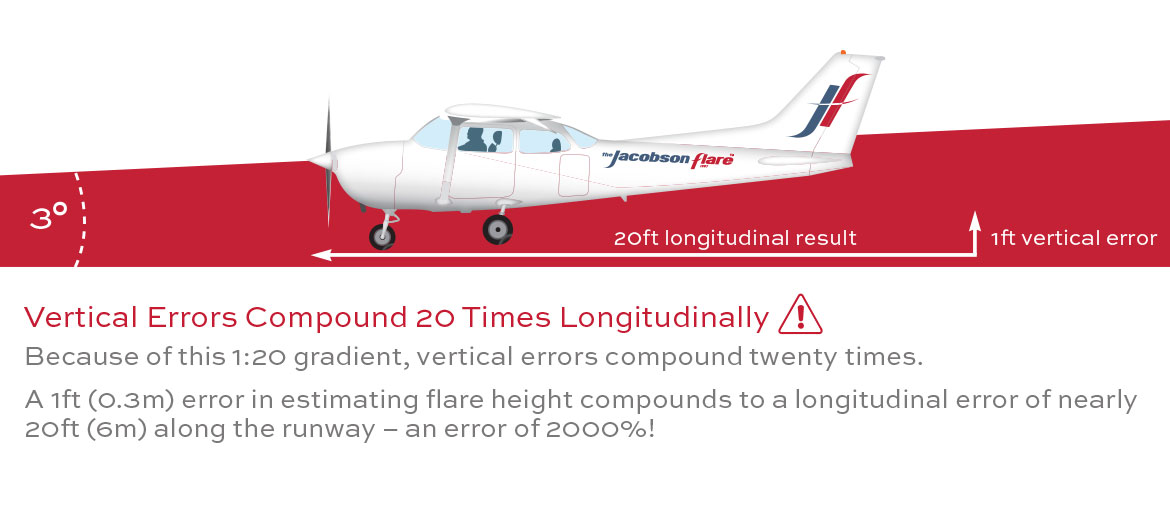
The adjacent (horizontal) side was simply ignored. If the flight path angle had been drawn more accurately at around 3º, instead of the typical 25-30º, it would have been recognised that the adjacent side is approximately 20 times larger than the opposite side. This means that any vertical error, made in guessing flare height, compounds 20 times longitudinally along the runway, greatly increasing the landing footprint. Moreover, the vertical side is invisible to the pilot.


In contrast, using a longitudinal flare cut-off point in determining a visual fix means that any error made in assessing the flare cut-off point position, in relation the the initial aim point, is reflected by only 1/20th of that error, vertically, making the flare initiation point much more accurate.  Moreover, the flare point, not to mention the entire landing flare manoeuvre, is fully visible to the pilot and tolerant of error, making the Jacobson Flare eminently suitable for unmarked gravel and grass airstrips.

The flare point calculation is only made once, for each airplane type (or variant) and the technique actually self-compensates (geometrically) for variations in flight (approach) path angle, runway slope and landing flap angle. The vertical height illusions, encountered when landing on an un-familiar narrower or wider runway can be discounted with a consistent and fully visible, longitudinal flare cut-off point, rather than a conventional guess of flare height.


So triangles and their structure work much better than antiquated guesswork.

When the penny drops, your ‘aha moment‘ will make you smile and that’s when the value of the Jacobson Flare will be appreciated.


Wishing you many safe landings


Captain David M Jacobson FRAeS MAP


Would you care to experience that unsurpassed sense of accomplishment, derived from executing consistently beautiful landings, more often?

For starters, Download the FREE Jacobson Flare LITE, our no fuss/no frills introduction. Here we demonstrate, step by step, the application of the Jacobson Flare on a typical grass airstrip at Porepunkah, YPOK.


We invite you to browse the consistently positive comments on our Testimonials page. Many pilots, of all levels of experience, have downloaded our Apps. Read about their own experiences with the Jacobson Flare technique and the App.

Then download the COMPLETE Jacobson Flare app – for iOS. You’re already possibly paying $300+/hour to hire an aeroplane: You’ll recover the cost of the app, in just ONE LESS-NEEDED CIRCUIT. Moreover, you’ll have an invaluable reference tool, throughout your entire life in aviation.

Download the COMPLETE Jacobson Flare App for iOS devices now.


We invite you, also, to review our new, FREE companion app,

offering a convenient way of staying abreast of our latest blogs.


Download the Jacobson Flare NEWS App for iOS devices now.

CaptainDavid Jacobson 1999_2015

If thousands of experienced pilots told you that having just one, or even no flight crew member was crazy …

If thousands of experienced pilots with millions of flying hours told you that having just one, or even no flight crew member was crazy, why would anyone believe an aviation executive who said it wasn’t?

Around the turn of the last century (known widely as ‘Y2K’), we used to joke of the flight crew of the future. The suggestion was that it consisted of one pilot and one dog: The ‘theory’ was that the Captain’s job was to feed the dog… And the dog’s job was to bite the Captain if he touched anything!

Many former and current professional pilots around the world are appalled at the recent discussion around someone’s pet idea to take this joke seriously and reduce the crew complement in airline flight decks to just one and inevitably, to zero human pilots.

Around Y2K, many computer-related disasters were anticipated, but they failed to materialise, for the most part.

However, if the aviation industry is stupid enough to consider a semi- or fully-autonomous flight deck, then, in my view, disasters will be commonplace. Why? Because the whole question of automation on the flight deck has been mishandled from the very beginning.

Computers make great monitors, but lousy pilots and humans make great pilots but less reliable monitors; and that is when we have a 2- or greater human crew complement. How will that turn out, with just one or less pilots on the flight deck?

Contributor David Hopkin, in ‘Human Factors in Aviation’, 1988, edited by Wiener and Nagle, wrote:

‘Human ineffectiveness in monitoring tasks must be reconciled with the requirements to keep and enhance high safety standards and to maintain the controller’s skills and active involvement.’

(dj NOTE: While this quote was directed towards automation in Air Traffic Control services, it is no less relevant for pilots.) 

Thomas B Sheridan wrote, in the same reference, above:

‘In assuming this new supervisory role, the pilot undertakes five functions:

  1. planning what to ask the computer to do;
  2. teaching (commanding, programming) the computer;
  3. monitoring its performance and detecting and diagnosing failures if they occur;
  4. intervening take over control directly if and when necessary and maintaining and repairing the semiautomatic systems; and
  5. learning from experience.’


David Nagel wrote, again in the same reference, above:

‘Finally, automation, which can have a very positive effect on both efficiency and safety, can also have a very depressing effect on safety. As pilots are removed from an active role in flying the aircraft, more and more that can only be termed “loss of situational awareness” are reported. These reports are particularly prominent when the automatic systems either fail to perform as expected or fail to perform at all.’

Well-known aviation veterans, including Captain Richard Champion De Crespigny and Captain Kevin Sullivan (both formerly with Qantas Airways Ltd) and Captain Chelsea ‘Sully’ Sullenberger have written extensively and authoritatively of their experiences with modern aviation technology in A380, A330 and A320 aircraft, respectively and have all sounded strong warnings following their personal leadership triumphs against very great odds. Their collective message is clear and I strongly endorse it.

Throughout an aviation career spanning 55 years and 24,500 hours (including nearly 5000 hrs as a flight instructor and embracing 40 years flying for Trans-Australia Airlines -TAA, Austalian Airlines Ltd and Qantas Airways Ltd, a pilot is bound to encounter some non-normal situations along the way. Licence renewal checks, conducted in modern and very sophisticated digital flight simulators offer fantastic, accelerated learning experiences for pilots at all levels, with zero safety risk to crews and airplanes.

However, unless a company flight training department – or an individual flight instructor/examiner – has some imagination, most exercises rely heavily on the manufacturer’s Quick Reference Handbook (QRH) and its unique and quite definitive Emergency and Non-Normal checklists for the airplane type.

Non-normal checklists don’t always cover the situation. The non-normal events that I experienced in F27, DC-9, B727 and B737 aircraft over that 40-year airline period, were more often than not either a combination of issues from more than one system, or an issue out of ‘left field’, that did not match, exactly, any non-normal checklist. The ability of pilots to think ‘outside the square’ is a definite advantage when, contrary to the nonsensical claims of the airplane manufacturers, partial, total and series of system failures do occur.

I can recall a pneumatic pressure regulator issue, double alternator failures (with resultant loss of engine and airframe de-icing systems in marginal, cold frontal icing conditions) and a nose-wheel tyre failure on landing, occurring successively in a single F27 night flight which we diverted into YMLT Launceston TAS rather than continue to YMHB Hobart. The second and third of these events were not covered by any published non-normal checklist.

I remember a trailing edge flap abnormality on a B737-400 where the flaps did extend to 5º as selected, BUT the flap gauge information was corrupted by a faulty sender. There was no published non-normal checklist for this event, either, so we had to consider and adopt the most suitable alternative, namely an assumed trailing-edge flaps up procedure with a consequential approach speed of 181 knots IAS into YPAD Adelaide SA.


The Automatics

On a B727 flight, the single autopilot ‘ALTITUDE HOLD’ function failed early into a 3-hour PER-MEL flight. Initially, my captain and I took 20-minute turns to hand-fly the heavy aircraft at 31,000ft, before experimenting, successfully, to engage MACH HOLD and then carefully monitoring and adjusting the thrust settings to maintain our assigned level (altitude) within limits!

The two autopilots on the B737-300/-400/ and -800 were, for the most part, quite accurate and reliable in general route flying and when executing precision instrument approaches. However, in 15,000 hrs on the B737, I never once experienced an automatic landing that was as good as the performance of a human pilot – especially if that pilot was applying the Jacobson Flare! These autolands were clumsy, to say the least, with the touchdown point quite haphazard in terms of their consistency of touchdown position and impact. Some even had to be aborted and a manual landing executed to prevent a mis-landing incident or accident.


The Human Element

During my 40 years of airline flying, there were many reported instances of flight crew incapacitation – we were trained for it. It happens. One B727 captain suffered a burst stomach ulcer and the first officer and flight engineer assumed command of the aircraft.

I experienced one such event when my first officer suffered a severe bout of food poisoning, half-way through a 4-hour MEL-PER flight. I completed the decent, approach and landing with a highly experienced cabin crew member as an assistant, to read checklists and monitor my responses against the many configuration changes. She also contributed greatly to our successful ground taxy in to the YPPH terminal.

The bottom line for me and for countless numbers of other professionals is that a fully trained, professional flight crew complement of 2- or more human pilots is indispensable.

So, to the decision makers:

If thousands of experienced pilots with millions of flying hours told you that having just ONE, or even NO crew member was crazy, why would anyone believe an aviation executive who said it wasn’t?

Ignoring pre-existing airline risk and threat assessment and management training for a minimal, perceived saving in flight crew costs just doesn’t bear comparison with the very probable loss of an airliner, its human loss and financial aftermath.

So why do it?


References:

  • ‘Human Factors in Aviation’, 1988, Edited by Earl L.Wiener and David C. Nagle
  • www.jacobsonflare.com


Wishing you many safe landings


Captain David M Jacobson FRAeS MAP


Would you care to experience that unsurpassed sense of accomplishment, derived from executing consistently beautiful landings, more often?

For starters, Download the FREE Jacobson Flare LITE, our no fuss/no frills introduction. Here we demonstrate, step by step, the application of the Jacobson Flare on a typical grass airstrip at Porepunkah, YPOK.


We invite you to browse the consistently positive comments on our Testimonials page. Many pilots, of all levels of experience, have downloaded our Apps. Read about their own experiences with the Jacobson Flare technique and the App.

Then download the COMPLETE Jacobson Flare app – for iOS. You’re already possibly paying $300+/hour to hire an aeroplane: You’ll recover the cost of the app, in just ONE LESS-NEEDED CIRCUIT. Moreover, you’ll have an invaluable reference tool, throughout your entire life in aviation.

Download the COMPLETE Jacobson Flare App for iOS devices now.


We invite you, also, to review our new, FREE companion app,

offering a convenient way of staying abreast of our latest blogs.


Download the Jacobson Flare NEWS App for iOS devices now.

The Jacobson Flare Lite now a video on YouTube

For some time, we’ve been asked to produce a Jacobson Flare – Lite: a simplified version, free of diagrams and the geometry and trigonometry that underpins the Jacobson Flare. We understand that there are some who feel that they wouldn’t understand a formal approach and landing technique, even if based on some very basic mathematics.

A picture is always better than a thousand words, but a real picture is unassailable; and we have a real approach and landing video, viewed from the cockpit. The downloadable, no-frills PDF presentation from our website homepage presents the practical application of the Jacobson Flare at YPOK Porepunkah, a grass-surfaced country airstrip at the foot of Mount Buffalo, in NE Victoria, Australia, based on a video from the Jacobson Flare App. The example airplane is the C172 and the images are a carefully selected group of screenshots from the video to assist pilots to identify, illustrate, resolve and integrate the five key elements of the approach and landing, namely:

1. Where to aim;

2. How to aim;

3. When to flare;

4. How much to flare; and

5. How fast to flare.

Now, the Jacobson Flare Lite has been published as a video on YouTube.

Each step is explained as simply as possible, through some brief notes, appended below each image. We suggest that you run the video through first, without any interruption, as an overview, before reviewing each of the selected screen images, in detail.

While the concept of using individual pages allows reading in your own time, it is useful to re-run the video at any time, to visualise application of the notes in real-time; the more times, the better.

Note: Use the video controls to pause, if more time is required to view a slide.


Wishing you many safe landings


Captain David M Jacobson FRAeS MAP


Would you care to experience that unsurpassed sense of accomplishment, derived from executing consistently beautiful landings, more often?

For starters, Download the FREE Jacobson Flare LITE, our no fuss/no frills introduction. Here we demonstrate, step by step, the application of the Jacobson Flare on a typical grass airstrip at Porepunkah, YPOK.


We invite you to browse the consistently positive comments on our Testimonials page. Many pilots, of all levels of experience, have downloaded our Apps. Read about their own experiences with the Jacobson Flare technique and the App.

Then download the COMPLETE Jacobson Flare app – for iOS. You’re already possibly paying $300+/hour to hire an aeroplane: You’ll recover the cost of the app, in just ONE LESS-NEEDED CIRCUIT. Moreover, you’ll have an invaluable reference tool, throughout your entire life in aviation.

Download the COMPLETE Jacobson Flare App for iOS devices now.


We invite you, also, to review our new, FREE companion app,

offering a convenient way of staying abreast of our latest blogs.


Download the Jacobson Flare NEWS App for iOS devices now.

Were you just taught to land? … or were you taught HOW to land?

Many of us are familiar with the adage that ‘it is more valuable to teach someone HOW to fish, than to simply buy them one’. 

There is quite a difference: One is momentary – the other is forever. Landing training is similar.

‘Just taught to land’

Historically, instruction in determining a suitable and consistent landing flare height for each airplane type has been more an art passed on to an apprentice than the formal teaching of a technical skill. Pilots then attempt to recognise and recycle that flare height, consistently, by familiarity and repetition.

The student is expected to remember and reproduce this flawed height estimation, often at another airfield where the visual cues are always different and are offered no alternative: Trial and error have been the arbiters in advancing the soundness of this developing judgement.

Unfortunately, even after the basic skills have been mastered, the same fundamental problem exists because every airplane type requires a different flare height. When needed most – effectively, all the time – an accurate and universal flare model had never been available. After being endorsed on a new airplane type, experienced pilots generally consolidate their assessment of flare-height *. Although subject to the same issues, they become comfortable with the ‘feel’ of their new airplane after some indeterminate time and land it as well as any flown previously – if inconsistently; clearly so, for this method has been accepted and practised for a very long time; in fact, since the end of World War One, in 1918.

(* Even the concept of a ‘flare height’ is flawed mathematically, for every error in judging/estimating/guessing this vertical height compounds by approximately twenty (20) times longitudinally, along the runway.)

It is what is meant, here, by being ‘just taught to land’ by imitating and replicating our instructors’ demonstrations. It is worth keeping in mind that that is how they were taught, too!

‘Being taught HOW to land’

The distinction is very simple: Were you ever encouraged to consider the following five questions and research their answers?

  1. Where to aim?  (your eyes at a nominated aim point on the runway, suitable for the aircraft type)
  2. How to aim?  (using the controls correctly to fly a consistent, stabilised approach path)
  3. When to flare?  (using a simple visual fix to locate an accurate flare point – rather than guessing an elusive and flawed* flare height)
  4. How much to flare?  (utilising a second aim point, together with:
  5. How fast to flare?  (a simple means of developing the perfect flare – an exponential curved eye- and flightpath that we have all been trying – with mixed results – to emulate through judgment, repetition and feel).

The simple explanations and solutions for these five questions – on HOW to apply this technique to ANY fixed-wing airplane on ANY airstrip or runway – and much more – are described in the comprehensive 345-page Jacobson Flare App.

You will then understand the difference between being taught to land and being taught HOW to land.


Wishing you many safe landings


Captain David M Jacobson FRAeS MAP


Would you care to experience that unsurpassed sense of accomplishment, derived from executing consistently beautiful landings, more often?

For starters, Download the FREE Jacobson Flare LITE, our no fuss/no frills introduction. Here we demonstrate, step by step, the application of the Jacobson Flare on a typical grass airstrip at Porepunkah, YPOK.


We invite you to browse the consistently positive comments on our Testimonials page. Many pilots, of all levels of experience, have downloaded our Apps. Read about their own experiences with the Jacobson Flare technique and the App.

Then download the COMPLETE Jacobson Flare app – for iOS. You’re already possibly paying $300+/hour to hire an aeroplane: You’ll recover the cost of the app, in just ONE LESS-NEEDED CIRCUIT. Moreover, you’ll have an invaluable reference tool, throughout your entire life in aviation.

Download the COMPLETE Jacobson Flare App for iOS devices now.


We invite you, also, to review our new, FREE companion app,

offering a convenient way of staying abreast of our latest blogs.


Download the Jacobson Flare NEWS App for iOS devices now.

35th Anniversary of the First Publication of the Jacobson Flare

35th Anniversary of the First Publication of the Jacobson Flare

The original Paper, ‘Where to Flare‘, written and presented by Captain David M Jacobson for the 1987 Australian Aviation Symposium, Canberra ACT, Australia, developed to become The Jacobson Flare.

18-20 November 2022 marks the 35th anniversary of the publication of the original Paper.


An abridged version of this paper appeared shortly after, in the Australian Department of Transport’s Aviation Safety Digest No 134 Spring 1987 edition.


For over 100 years aviators have, for the most part, known WHAT we are trying to achieve when landing an aeroplane; it’s the HOW that has been so elusive.

My long-held view is that the visual approach and landing manoeuvre is the worst taught and most neglected topic in the entire flight training syllabus, both civil and military because, until 1987, there had never been a universal, quantifiable and consistently reliable approach and landing training technique. A loose collection of myths and misinformation, opinions and guesswork do not qualify.

37 years ago, I developed a solution. However, the industry is yet to realise that it has a problem. The pathetic fallback, ‘We’ve always done it, this way’, is just not good enough, anymore.

If you agree, contact me and let us start a conversation on how you can introduce the Jacobson Flare to your Flight School or College training syllabus.

Please visit www.jacobsonflare.com and its various tabs. I commend The Jacobson Flare LITE.pdf as the best introduction yet for those new to this subject.
Here is a response from a former RAAF Air Commodore. I look forward to yours.


Wishing you many safe landings


Captain David M Jacobson FRAeS MAP


Would you care to experience that unsurpassed sense of accomplishment, derived from executing consistently beautiful landings, more often?

For starters, Download the FREE Jacobson Flare LITE, our no fuss/no frills introduction. Here we demonstrate, step by step, the application of the Jacobson Flare on a typical grass airstrip at Porepunkah, YPOK.


We invite you to browse the consistently positive comments on our Testimonials page. Many pilots, of all levels of experience, have downloaded our Apps. Read about their own experiences with the Jacobson Flare technique and the App.

Then download the COMPLETE Jacobson Flare app – for iOS. You’re already possibly paying $300+/hour to hire an aeroplane: You’ll recover the cost of the app, in just ONE LESS-NEEDED CIRCUIT. Moreover, you’ll have an invaluable reference tool, throughout your entire life in aviation.

Download the COMPLETE Jacobson Flare App for iOS devices now.


We invite you, also, to review our new, FREE companion app,

offering a convenient way of staying abreast of our latest blogs.


Download the Jacobson Flare NEWS App for iOS devices now.